

Breaking
Sponsor Advertisement
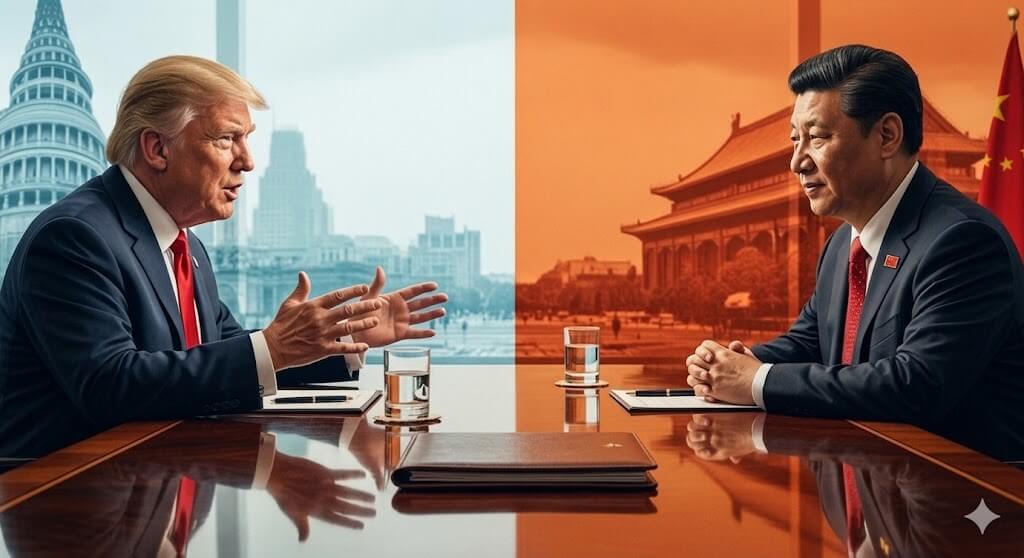
President Trump Praises Xi Jinping, Emphasizes Cooperation at Beijing Summit
Image for: President Trump Praises Xi Jinping, Emphasizes Cooperation at Beijing Summit

President Trump Praises Xi Jinping, Emphasizes Cooperation at Beijing Summit

President Donald Trump met with Chinese President Xi Jinping in Beijing, calling him "a great leader" and stressing the importance of cooperation between the two nations amid ongoing trade and geopolitical tensions.
Jump to The Flipside Perspectives

President Donald Trump engaged in high-level diplomatic discussions with Chinese President Xi Jinping during a summit in Beijing on Thursday, underscoring the critical importance of cooperation between the world’s two largest economies. During their face-to-face meeting, President Trump offered significant praise for his Chinese counterpart, remarking, "You are a great leader." He further elaborated, "Sometimes people don’t like me saying it, but I say it because it’s true. I always say the truth."

"You are a great leader." — President Donald Trump, Speaking to Chinese President Xi Jinping

The President's remarks came as he led a delegation of Cabinet officials and business executives to Beijing for a series of economic and diplomatic engagements. The American delegation had arrived in China Wednesday evening U.S. time, receiving a welcome from Chinese Vice President Han Zheng before the formal summit events commenced.

This summit unfolds against a backdrop of persistent and complex tensions between the United States and China. Key areas of disagreement include ongoing trade disputes, the imposition of tariffs, intense competition in technology, and broader geopolitical rivalries across Asia and the Pacific region. Despite these challenges, the leaders' public statements emphasized a shared desire for stability and partnership.

During a state dinner that was part of the summit agenda, President Trump extended an invitation to President Xi and his wife, Peng Liyuan, to visit the White House on September 24 for further discussions. President Xi's last visit to the White House occurred in 2015 during the Obama administration. More recently, he traveled to the U.S. for the Asia-Pacific Economic Cooperation (APEC) summit in San Francisco in 2023. President Trump and President Xi have a history of prior meetings, including at the APEC summit in South Korea last year, and several other encounters during President Trump's first term, such as hosting Xi at Mar-a-Lago in 2017 and subsequent gatherings in Beijing, Argentina, and Japan.

In his remarks at the state dinner, President Trump characterized the U.S.-China relationship as "one of the most consequential relationships in world history." He highlighted the deep historical and cultural ties between the two nations, citing Benjamin Franklin's writings about Confucius and acknowledging the influence of Chinese culture within the United States. President Trump also recognized the vital role of Chinese immigrants in the construction of American railroads and noted the widespread popularity of American products and culture throughout China. "Chinese restaurants in America today outnumber the five largest fast food chains in the United States all combined," President Trump stated, illustrating the cultural integration.

President Trump further emphasized what he described as shared values between the American and Chinese people, including a strong work ethic, commitment to family, and patriotism, as reported by Conservative Brief. He articulated a vision for the future, stating, "Together, we have the chance to draw on these values, to create a future of greater prosperity, cooperation and happiness and peace for our children."

Chinese President Xi Jinping echoed the sentiment of the importance of stable relations between Washington and Beijing, describing the partnership as the world's most significant bilateral relationship. Through a translator, President Xi affirmed, "Both China and the United States stand to gain from cooperation and lose from confrontation." He concluded his remarks by asserting, "Our two countries should be partners rather than rivals," signaling China's willingness to pursue future economic and diplomatic cooperation. The summit's outcomes are expected to set a tone for future interactions between the two global powers, impacting various aspects of international trade, technology, and geopolitical stability.

Advertisement

The Flipside: Different Perspectives

Progressive View

From a progressive viewpoint, President Trump's praise for Chinese President Xi Jinping raises significant concerns regarding human rights, democratic values, and the moral standing of the United States on the global stage. While diplomatic engagement is necessary, progressives argue that such effusive praise for a leader presiding over an authoritarian regime, known for its extensive human rights abuses, suppression of dissent, and actions against ethnic minorities, risks normalizing and emboldening such behavior. It can be perceived as undermining the principles of democracy and universal human rights that the U.S. ostensibly champions.

Progressives emphasize that U.S. foreign policy should consistently reflect its values, advocating for social justice, equity, and the collective well-being of all people. This includes holding nations accountable for their human rights records and labor practices, rather than overlooking them for perceived economic or strategic gains. The focus on bilateral deals, while potentially yielding short-term economic benefits, may neglect broader systemic issues and the need for multilateral cooperation to address global challenges like climate change, pandemics, and democratic erosion. A progressive approach would call for a more critical engagement with China, one that prioritizes human rights, fair labor standards, and environmental protection, ensuring that economic cooperation does not come at the expense of core ethical principles.

Conservative View

From a conservative perspective, President Trump's engagement with Chinese President Xi Jinping exemplifies a pragmatic approach to foreign policy, prioritizing American interests through direct, leader-to-leader diplomacy. The President's praise for Xi can be viewed not as an endorsement of China's authoritarian system, but as a strategic diplomatic maneuver aimed at de-escalating tensions and creating an environment conducive to achieving specific American objectives. Conservatives often advocate for a strong stance against unfair trade practices, intellectual property theft, and currency manipulation by China. By engaging directly, President Trump demonstrates a willingness to negotiate tough deals that protect American jobs, enhance national security, and ensure fair market access for U.S. businesses.

This direct engagement aligns with the conservative principle of robust national sovereignty, where the U.S. asserts its economic and strategic priorities without relying excessively on multilateral institutions that may dilute national interests. The emphasis on shared values like hard work and family, as highlighted by President Trump, can be seen as an attempt to find common ground for cooperation, even amidst ideological differences, to foster peace and prosperity. For conservatives, the goal is to manage the challenging U.S.-China relationship effectively, ensuring that any cooperation ultimately serves to strengthen America’s economic standing and global influence, while simultaneously addressing concerns about China's growing military and technological power.

Common Ground

Despite significant ideological differences, both conservative and progressive viewpoints recognize the undeniable importance of a stable and functional relationship between the United States and China. There is broad agreement that managing this complex relationship is paramount for global economic stability and international peace, as both nations are integral to the global supply chain and economic health. Both sides share an interest in avoiding direct conflict and managing economic competition through established diplomatic channels.

Furthermore, there is a shared understanding that cooperation is necessary on critical global issues that transcend national borders, such as climate change, pandemic preparedness, and nuclear non-proliferation. While the approaches to these challenges may differ, the shared objective of finding solutions remains. Maintaining open lines of communication, even during periods of intense disagreement, is seen as a pragmatic necessity by both conservatives and progressives to prevent misunderstandings and de-escalate potential conflicts. Ultimately, both perspectives acknowledge that despite the rivalry, the two nations must find ways to coexist and engage constructively for the benefit of their respective populations and the wider world.

What's your view on this story? Share your thoughts and remember to consider multiple perspectives and being respectful when forming and voicing your opinion. "If you resort to personal attacks, you have already lost the debate..."

Advertisement

Contact Us About This Article

Have a question or comment about this article? We'd love to hear from you.

About Fair Side News

At Fair Side News, we believe in presenting news with perspectives from both sides of the political spectrum. Our goal is to help readers understand different viewpoints and find common ground on important issues.