


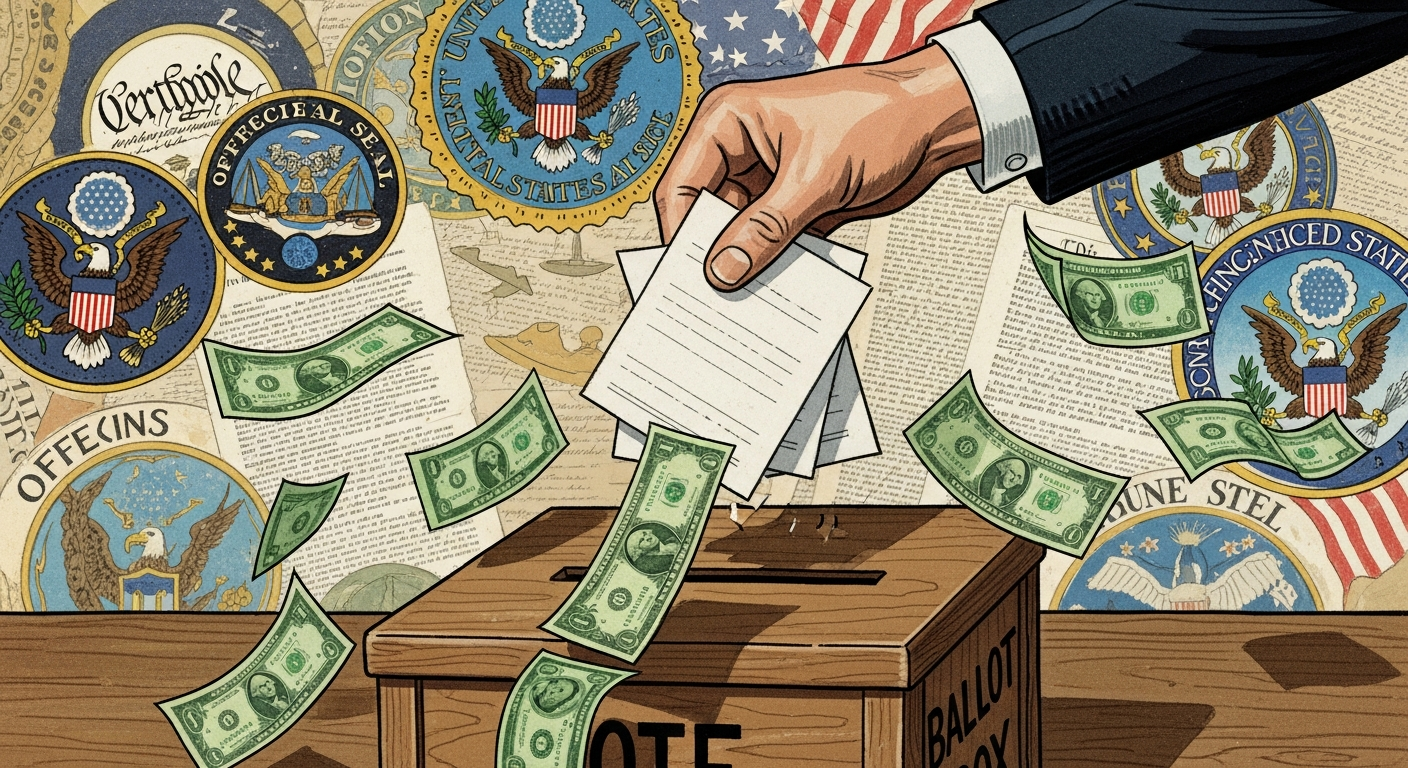
LOS ANGELES, California — A California resident has entered a guilty plea in a federal voter registration fraud case, admitting to her involvement in a two-decade-long scheme that included paying individuals for petition signatures and voter registration forms. Brenda Lee Brown Armstrong, 64, of Marina del Rey, acknowledged her participation in the extensive operation that spanned across various ballot initiative campaigns and involved the handling of election-related documents for many years.
"False registrations undermine Americans’ faith in elections—even more so when payoffs are involved. This Justice Department is committed to ensuring that all U.S. elections are fair and free from illegal meddling—so that all Americans can accept the results with confidence." — Assistant Attorney General Harmeet K. Dhillon, Civil Rights Division, Justice Department
Federal prosecutors detailed in court filings that Armstrong operated within a structured signature-gathering system where compensation was directly tied to the volume of valid petition signatures submitted. Authorities allege that Armstrong actively encouraged individuals to complete voter registration forms and petitions, including those not previously registered to vote. The Department of Justice (DOJ) stated that Armstrong "regularly paid and offered to pay individuals cash, usually in amounts between $2 and $3, to induce them to sign her petitions." Furthermore, prosecutors accused her of submitting voter registration materials that contained inaccurate or false information, violating federal election documentation requirements.
While court records do not specify the exact total number of fraudulent voter registration forms or petition signatures involved, prosecutors underscored that the illegal conduct occurred over multiple years and was connected to several California ballot initiative campaigns. A significant portion of these activities reportedly took place in Los Angeles County, with outreach efforts extending to Skid Row, where individuals experiencing homelessness were allegedly approached and incentivized to complete election-related paperwork.
First Assistant U.S. Attorney Bill Essayli emphasized the gravity of the offenses, stating that Armstrong's actions constituted a clear violation of federal election law. "Today’s an example where fraud did occur. Not only did Ms. Brown pay people to register to vote, which is illegal, it is a federal crime," Essayli said, further adding, "She also induced them to place false information on the voter registration." This case serves as a tangible example of voter fraud, which federal authorities have committed to actively prosecuting.
Assistant Attorney General Harmeet K. Dhillon of the Justice Department’s Civil Rights Division commented on the broader implications of such cases, stating, "False registrations undermine Americans’ faith in elections—even more so when payoffs are involved. This Justice Department is committed to ensuring that all U.S. elections are fair and free from illegal meddling—so that all Americans can accept the results with confidence." Her statement highlights the DOJ's focus on maintaining public trust in the electoral process.
Officials involved in the investigation indicated that Armstrong participated in a system where petition circulators were compensated based on their output. Prosecutors contend that such a payment structure inherently carries compliance risks, particularly when financial incentives are directly linked to the sheer volume of signatures collected rather than their verified accuracy or legality. This method, they argue, can inadvertently or directly encourage fraudulent practices to meet quotas and maximize earnings.
Armstrong's plea agreement is expected to be a valuable tool in ongoing federal reviews of signature-gathering operations and third-party contractors frequently employed in ballot initiative campaigns. These reviews are part of the DOJ's broader and continuing enforcement efforts, which are specifically focused on ensuring compliance with election documentation standards and upholding voter registration integrity across the nation.
This particular case unfolds amidst a wider series of federal prosecutions targeting alleged voter registration fraud, falsified election documents, and unlawful voting activities reported in multiple states. Federal officials consistently cite these cases as evidence of their robust and ongoing enforcement of election laws, which govern registration accuracy and eligibility requirements. While California election officials have previously stated that the state has safeguards in place to detect fraudulent voter registrations and maintain system integrity, noting that all submitted forms undergo review and verification procedures under state election protocols, the federal prosecution underscores vulnerabilities that can be exploited.
Armstrong now faces severe penalties, including a maximum sentence of up to five years in federal prison, three years of supervised release, and a potential fine of $10,000 upon conviction. Her guilty plea and cooperation may prove instrumental in further federal investigations into related petition circulation practices and voter registration contracting operations, according to officials familiar with the ongoing matter. The investigation into the broader network and practices remains active.

