


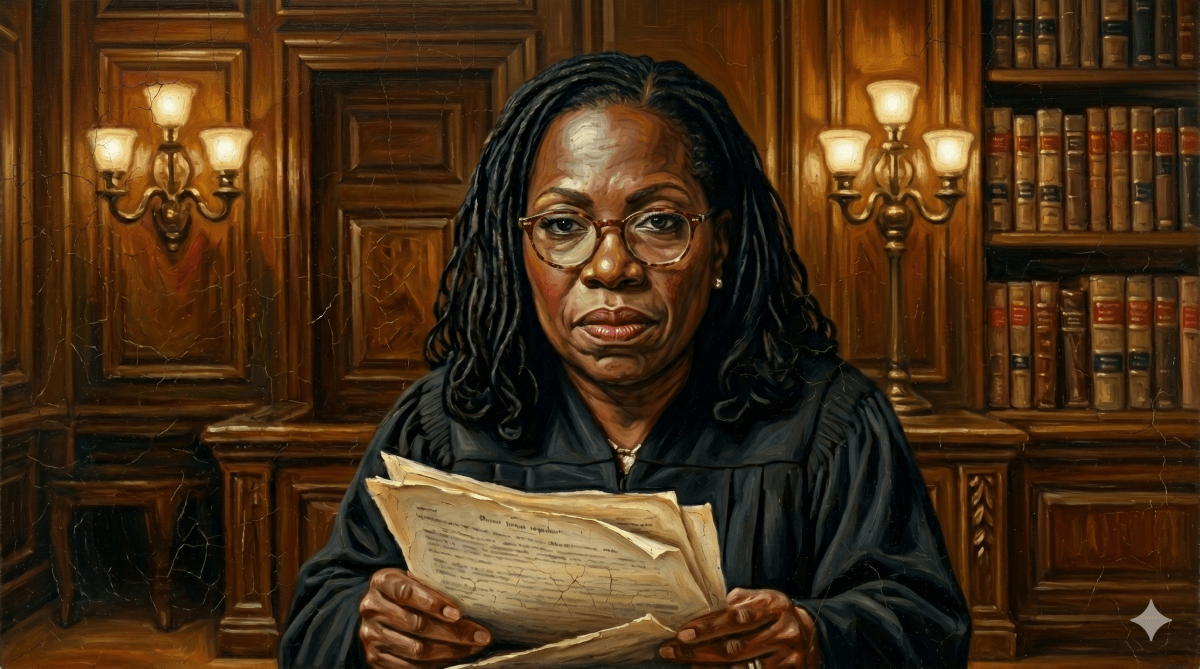
Supreme Court Justice Ketanji Brown Jackson publicly accused her eight fellow justices of enabling the appearance of political manipulation during a Monday address to the American Law Institute. Her criticism centered not on the substance of a recent ruling, but on a procedural maneuver by the Court to expedite its implementation, sparking a rare and sharp public confrontation within the nation's highest judicial body.
"It can so easily be perceived that the court is doing something political." — Justice Ketanji Brown Jackson, Associate Justice of the Supreme Court
The procedural move in question involved the Court's 8-1 vote to bypass the standard 32-day waiting period, as outlined in Supreme Court Rule 45.3, and immediately certify its decision in *Louisiana v. Callais*. This swift action cleared the way for Louisiana to redraw its congressional map without delay, impacting the electoral landscape potentially before the 2026 midterm elections. Rule 45.3 typically mandates this waiting period before a ruling is sent down to lower courts for enforcement, a practice designed to allow time for any final procedural matters or clarification.
Justice Jackson, appointed to the bench by President Biden, expressed significant concern over the Court's departure from this established norm. "It can so easily be perceived that the court is doing something political," she stated, emphasizing the need for judicial impartiality. She further elaborated on her apprehension, cautioning, "In my view, we have to be really, really careful in this environment when we’re dealing with issues that have a political overlay." Jackson underscored the importance of consistency, adding, "We have to be scrupulous about sticking to the principles and the rules that we apply in every case and not look as though we’re doing something different in this kind of context."
The underlying substantive decision in *Louisiana v. Callais* was a 6-3 ruling, authored by Justice Samuel Alito, which struck down Louisiana’s 2024 congressional map as an unconstitutional racial gerrymander. While Jackson joined the majority in the substantive ruling, she dissented alone from the procedural fast-track, arguing in a four-page written dissent that the Court’s expedited move "has spawned chaos in the State of Louisiana."
Justice Alito, however, remained unmoved by Jackson's procedural objections and responded with a forceful rebuttal. He contended that delaying the implementation of the ruling would have caused its own form of damage, stating, "The dissent [from Jackson] would require that the 2026 congressional elections in Louisiana be held under a map that has been held to be unconstitutional." Alito then escalated his response, describing Jackson’s reasoning as "baseless and insulting" and her central accusation as a "groundless and utterly irresponsible charge." He also pointed out that had the Court waited the full 32 days, such inaction could similarly have been characterized as a politically partisan move, potentially favoring those who defended the existing, unconstitutional map. Justices Clarence Thomas and Neil Gorsuch joined Alito in a concurring opinion, which notably stated that Jackson’s language "lacks restraint."
The ripple effects of the *Callais* ruling and the Court's swift procedural action extended rapidly beyond Louisiana’s borders, influencing redistricting efforts in several other states. Tennessee Republicans moved quickly, drawing and passing a new congressional map that eliminated the state’s only majority-minority House district. Florida legislators, who were already debating a redistricting measure, passed their own bill on the same day the *Callais* decision was issued. Alabama, currently operating under maps drawn by a court-appointed special master following a prior Supreme Court ruling, filed an emergency motion requesting the justices to allow its legislature’s original map to be reinstated. South Carolina is also among the states closely examining the *Callais* decision, viewing it as a potential precedent to redraw district lines in ways that could benefit Republican candidates ahead of the upcoming 2026 midterm elections.
Across the country, the fallout from the *Callais* decision and subsequent redistricting battles are now positioned to potentially yield a 10-to-12-seat advantage for Republicans in the House of Representatives. Such a gain could prove decisive in the broader struggle for control of the House in 2026. The public exchange between Justice Jackson and Justice Alito represents one of the most intense intracourt confrontations in recent memory, featuring a Biden appointee accusing the entire bench of political behavior, and three conservative justices responding by questioning her judgment and professional restraint.

