


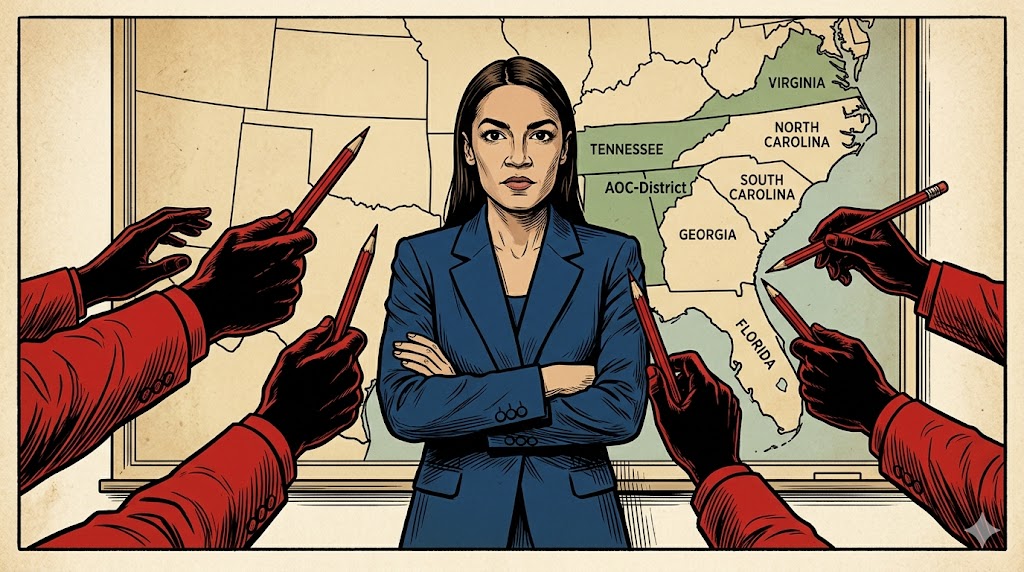
Representative Alexandria Ocasio-Cortez (D-NY) traveled to Alabama this week to deliver a passionate address, calling for national Democratic action against Republican-controlled state legislatures' aggressive redrawing of congressional district boundaries across the South. Her speech comes amidst a concerted effort by Republican lawmakers in several Southern states to reconfigure electoral maps ahead of the 2026 midterms, a move designed to dilute Democratic strongholds and fortify the Republican Party's narrow majority in the House of Representatives.
"It is time for the North to pull up to the South. It is time for New York to pull up to Alabama." — Rep. Alexandria Ocasio-Cortez (D-NY)
Speaking before an audience in Alabama, Ocasio-Cortez issued a direct appeal for Democrats nationwide to focus their efforts on Southern states. "It is time for the North to pull up to the South. It is time for New York to pull up to Alabama," she declared. She specifically named Georgia, Louisiana, Tennessee, and Mississippi as crucial battlegrounds, framing the ongoing redistricting as a "civil rights emergency." The congresswoman asserted that Republicans had underestimated the backlash their redistricting efforts would provoke, stating, "They think they can draw us out of power. They do not know the sleeping giant that they just awakened, because it is not a coincidence."
Ocasio-Cortez also linked voting rights directly to the success of federal social programs, arguing for their intrinsic connection. "Our whole country must understand that it was not until voting rights were ratified in this country that we got the Great Society, because when black Americans have the right to vote and that vote is protected, our schools get funded, when voting rights are health care gets expanded, when voting rights are protected, our country moves forward. And Montgomery, that’s what they’re actually afraid of," she told the crowd. She concluded her speech by characterizing the current redistricting battles as merely the initial phase of a more extensive political struggle. "They’re afraid of us coming together. They’re afraid of us protecting one another. Alabama is the crucible. Georgia is the crucible. Tennessee, Louisiana, Mississippi is the crucible, so if you are not from here, it is time to pull up. Because what they thought was the final blow is actually just the opening silo," Ocasio-Cortez stated, appearing to intend the phrase "opening salvo."
Her historical assertion regarding the Great Society and voting rights has drawn scrutiny. Conservative commentator Michael Knowles challenged Ocasio-Cortez's timeline, noting, "The first Great Society program went into effect a year before passage of the Voting Rights Act." Historical records corroborate this correction. President Lyndon B. Johnson launched his Great Society initiative with a commencement address at the University of Michigan in May 1964, outlining cornerstones such as poverty reduction, education, healthcare, and civil rights. Key Great Society legislation was enacted a full year before the Voting Rights Act was signed into law by President Johnson on August 6, 1965.
The political landscape driving Ocasio-Cortez's concerns is rapidly evolving. Republican-controlled legislatures in states including Louisiana, Alabama, and South Carolina are advancing redistricting plans, an effort encouraged by President Donald Trump, to secure advantages in congressional elections. This push has already had significant consequences, notably impacting Democratic representation.
On Friday, Democratic Representative Steve Cohen of Tennessee announced his decision not to seek re-election in the state’s ninth congressional district, a seat he has held since 2007. This decision follows the Tennessee legislature's recent redistricting action, which significantly altered his Memphis-based district. Cohen, who is Tennessee’s sole Democrat in Congress, stated, "This morning, I announced my decision not to run in any of the three gerrymandered congressional districts carved out of the 9th District that I have represented for more than 19 years." He further added, "Last week Tennessee Republicans silenced the Black vote here in Memphis to make Republican victories likely." Cohen indicated he would re-enter the race if Democratic legal challenges successfully block the newly drawn maps.
The Tennessee redistricting vote itself sparked considerable unrest within the state legislature. Activists protested from the gallery as the new map was approved, and Democratic lawmakers linked arms at the front of the chamber in a show of opposition. In response to what he described as encouragement of disorder during the vote, House Speaker Cameron Sexton subsequently stripped Democratic members of all committee assignments. Ocasio-Cortez, speaking prior to Cohen’s announcement, framed these developments not as defeats but as catalysts for further mobilization.

