


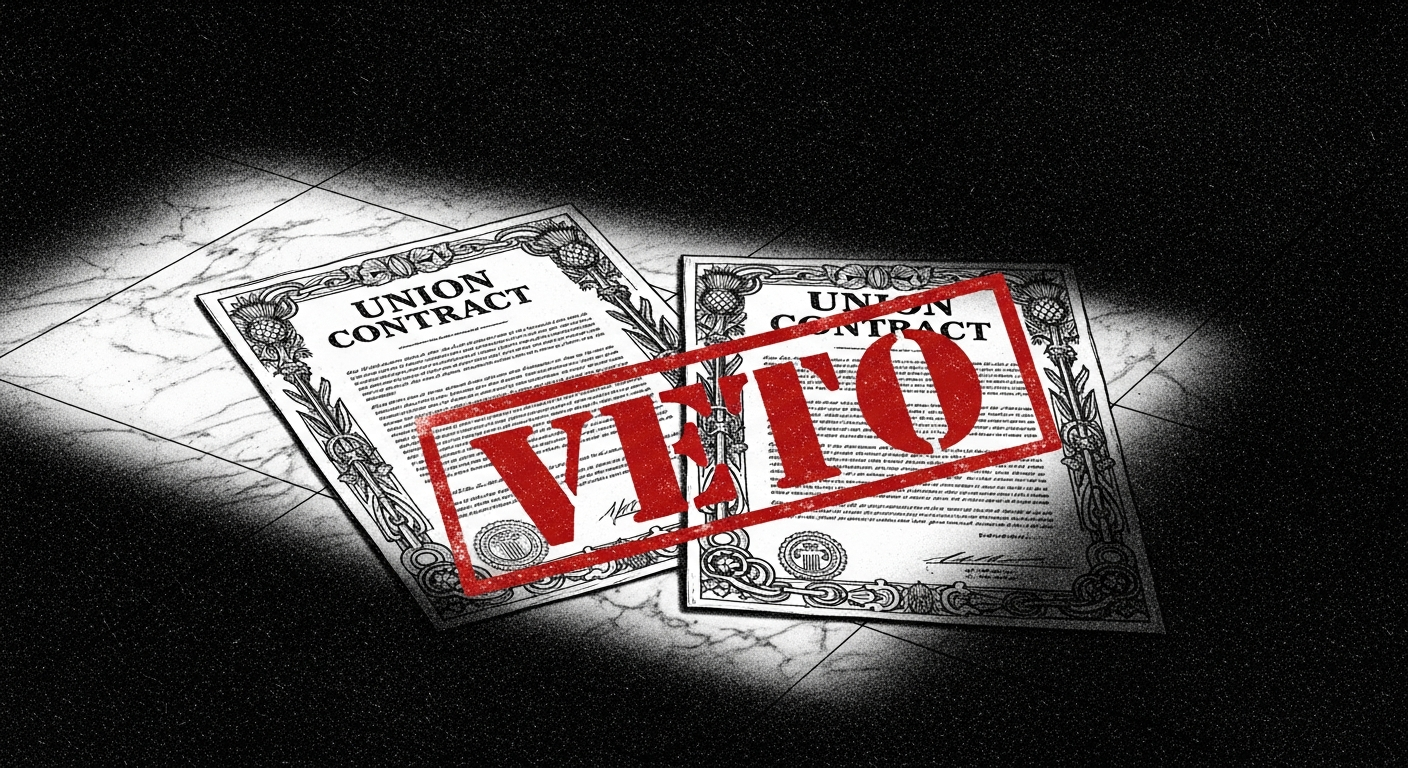
Virginia Attorney General Jay Jones last week publicly criticized Governor Abigail Spanberger's decision to veto two bills that would have expanded collective bargaining rights for public sector employees across the commonwealth. The public rebuke marks a notable divergence between the two high-ranking Democrats, particularly given Governor Spanberger's steadfast support for Jones during his contentious election campaign just six months prior.
"The Governor is charged with making hard decisions in an office that carries extraordinary responsibility, but I join union members, home care workers, public servants, and working families across the Commonwealth in their disappointment in today’s veto." — Jay Jones, Virginia Attorney General
The Attorney General's public statement follows a challenging election cycle for Jones, who faced significant scrutiny in October 2025 after text messages he sent in 2022 became public. In these messages, Jones made highly inflammatory remarks about then-Republican Virginia House Speaker Todd Gilbert, including expressing a hope that Gilbert's children would die. The revelations ignited a political firestorm, drawing widespread condemnation and calls for Governor Spanberger to withdraw her endorsement of Jones, who was running for Attorney General on the same ticket as her gubernatorial bid.
Despite intense pressure from reporters and political opponents, Governor Spanberger refused to directly withdraw her endorsement. During a debate against Republican Lieutenant Governor Winsome Sears, Spanberger acknowledged the texts as "abhorrent" but stopped short of disavowing Jones as a running mate. As questions continued on the campaign trail, Spanberger's frustration became evident. "The fact that I have to spend even a moment’s time talking about somebody else’s text message from years ago rather than what I want to do as governor is something that I am deeply unhappy about," she told Katie Couric in an interview at the time. Her campaign continued to sell merchandise featuring Jones's name, and she ultimately maintained her support through Election Day.
In November, Virginia voters delivered a commanding victory for Governor Spanberger, who defeated Sears by a margin exceeding 15 points. Attorney General Jones also secured his victory, beating incumbent Republican Attorney General Jason Miyares by six points. However, Jones's margin was nearly nine points lower than Spanberger's, highlighting the impact of the controversies on his individual performance. Political analysts had widely predicted that Jones's success was heavily dependent on Spanberger's strong showing. Richmond political analyst Bob Holsworth told The Washingtonian before Election Day, "Jones’s fate is dependent on Spanberger winning by double digits or close to double digits for him to have a chance." Reports from The Hill at the time indicated that Democratic strategists were concerned about a potential split-ticket outcome, where voters might support Spanberger but not Jones. Ultimately, Jones's victory was secured, largely attributed by many observers to his association with the popular gubernatorial candidate.
Last Thursday, Governor Spanberger vetoed Senate Bill 378 and House Bill 1263. These bills, which had passed the General Assembly with near-unanimous Democratic support, aimed to allow most public employees statewide to organize and negotiate over wages, benefits, and workplace conditions. Current Virginia law requires local governments to grant explicit permission before any collective bargaining can occur. Governor Spanberger had previously attempted to amend the legislation, proposing changes that were subsequently rejected by the General Assembly, leading to the original bills being returned to her desk for final action.
Following the veto, Attorney General Jones promptly issued a public statement to local reporter Brandon Jarvis, expressing his disappointment. "The Governor is charged with making hard decisions in an office that carries extraordinary responsibility, but I join union members, home care workers, public servants, and working families across the Commonwealth in their disappointment in today’s veto," Jones stated. This public criticism of the Governor by her Attorney General, particularly on a significant policy matter, has drawn attention due to their recent political history.
While Jones expressed disappointment, Virginia House Republican leader Terry Kilgore welcomed the Governor's veto, asserting that the bill "would have driven up local taxes unsustainably." The differing reactions underscore the contentious nature of expanding collective bargaining rights for public sector workers, a policy debate with significant implications for state and local budgets, as well as worker protections.
The public disagreement between Attorney General Jones and Governor Spanberger raises questions about the cohesion within the state's Democratic leadership. Many political observers note that Jones's current position as Attorney General is widely considered a direct result of Governor Spanberger's decision to maintain her endorsement and campaign support, even in the face of severe controversy. His willingness to publicly criticize her on a key legislative matter, despite this political lifeline, is seen by some as a surprising move so early in his tenure.
As the legislative session concludes, the veto of the collective bargaining bills and the subsequent public commentary from Attorney General Jones highlight ongoing policy differences and potential political fault lines within Virginia's government, signaling a dynamic political landscape for the coming years.

