


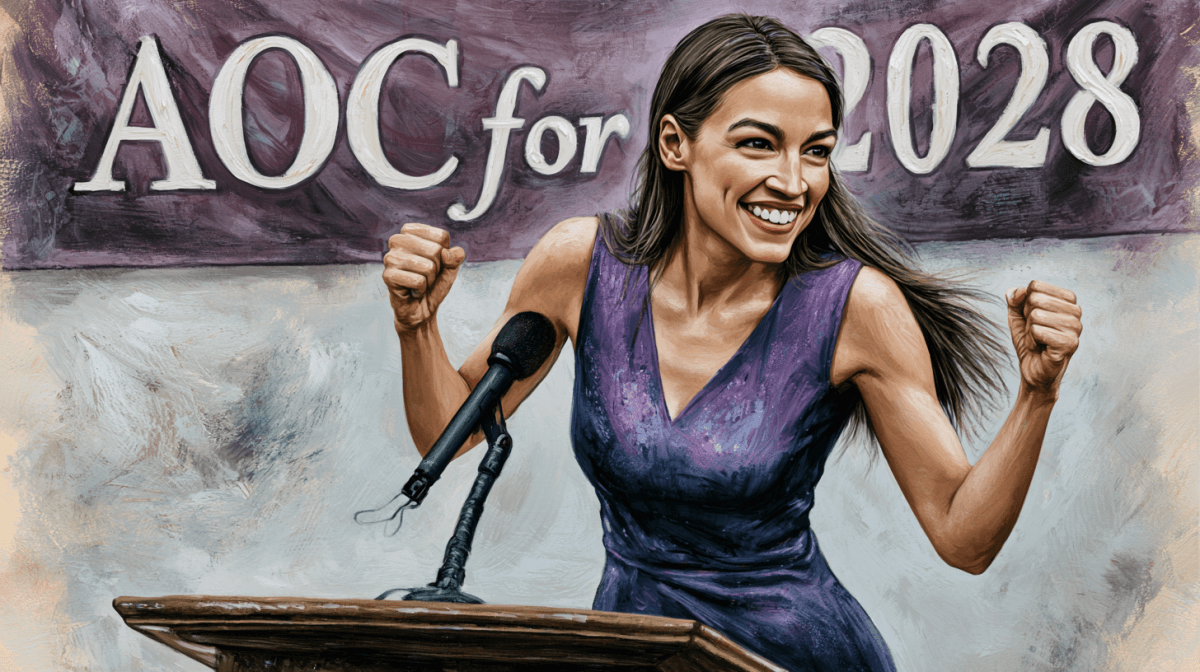
A new poll released by AtlasIntel, a firm consistently recognized for its accuracy in election forecasting, places Representative Alexandria Ocasio-Cortez (D-NY) at the forefront of the potential 2028 Democratic presidential primary field. The survey, conducted between May 4 and May 7, 2025, among 2,069 American adults, shows Ocasio-Cortez garnering 26 percent support, a first for the New York congresswoman in any published poll measuring the Democratic presidential primary. The poll carries a margin of error of plus or minus two percentage points.
Following Ocasio-Cortez in the AtlasIntel survey are Pete Buttigieg, who served as Transportation Secretary under President Biden, with 22.4 percent, and California Governor Gavin Newsom, who secured 21.2 percent. Kamala Harris, who lost the 2024 presidential race to President Donald Trump, registered 12.9 percent, placing her fourth. No other potential candidate in the field managed to reach double-digit support.
AtlasIntel's methodology and accuracy have received commendation from prominent figures in election analysis. Nate Silver, a statistician known for his election forecasting, rated AtlasIntel as the single most accurate pollster of the 2024 election cycle. The firm also earned the same distinction for its performance during the 2020 race, according to the polling aggregator 538. This track record lends weight to the firm's early insights into the nascent 2028 Democratic contest.
While the 2028 presidential race is still years away from formal declarations, prospective candidates have already begun preliminary activities. These include traveling to early primary states, testing political messages, and working to build name recognition among voters. Political observers anticipate that the campaign launch window could open following the 2026 midterm elections. In this pre-campaign environment, early polling numbers serve as a crucial metric, attracting donor contributions, generating media coverage, and signaling viability to party insiders and potential supporters.
Representative Ocasio-Cortez has not formally declared a presidential campaign. When questioned about her future political aspirations in a conversation with David Axelrod, a former senior strategist for President Barack Obama, she articulated her motivations in terms of policy rather than a specific office. "My ambition is to change this country," Ocasio-Cortez stated. "Presidents come and go. Senate, House seats, elected officials come and go. But single-payer healthcare is forever. A living wage is forever, workers’ rights are forever, women’s rights, all of that, and so anyways…to a finer point to your question is that when you aren’t attached, right, when you haven’t been like fantasizing about being this or that since the time you were 7 years old, um, it is tremendously liberating."
Beyond a potential presidential bid, Ocasio-Cortez has also been mentioned as a possible candidate for a Senate seat. Current Senate Minority Leader Chuck Schumer faces reelection, and some progressive factions have encouraged her to challenge him in a primary should he seek another term. Her substantial standing among progressive voters is noted, with supporters viewing her as a credible figure to lead the left-wing effort to reclaim the presidency in 2028. She has demonstrated an ability to generate enthusiasm, particularly among younger voters, a demographic that former Vice President Harris reportedly struggled to mobilize against President Trump in 2024.
However, a segment of the Democratic establishment has expressed reservations that Ocasio-Cortez's progressive policy positions might prove challenging to market to the swing voters who often determine general election outcomes. This internal debate echoes discussions that followed the 2024 loss, where some Democrats concluded that Harris's performance was hampered by perceptions that her ideology was out of step with the political center. Ocasio-Cortez also recently faced scrutiny from some fellow progressives after declining to collaborate with former Representative Marjorie Taylor Greene on policy related to Gaza, publicly citing a lack of trust in Greene, whom she described as a "proven bigot and antisemite."
The AtlasIntel poll results contrast with data from other polling firms and real-money prediction markets, which aggregate trader wagers into probability estimates. On Kalshi, a prediction market platform, Governor Gavin Newsom leads all Democratic contenders with a 25 percent chance, followed by Harris at 9.1 percent and Ocasio-Cortez at 8.2 percent. Polymarket shows similar figures, with Newsom at 24 percent, Harris at 9 percent, and Ocasio-Cortez at 8 percent.
Other traditional polls also present a different picture. A Harvard/Harris poll of 2,745 registered voters, conducted April 23–26 with a margin of error of plus or minus 1.87 percentage points, placed Harris at 50 percent, a figure that had steadily climbed from 39 percent in January. Newsom followed at 22 percent, with Pennsylvania Governor Josh Shapiro at 9 percent, Ocasio-Cortez at 8 percent, and Illinois Governor J.B. Pritzker at 6 percent. Similarly, a YouGov survey of 2,189 adults, conducted April 8–13 with a margin of error of plus or minus 2.8 percentage points, showed Harris first at 24 percent, followed by Newsom at 12 percent. Ocasio-Cortez and Buttigieg each registered 9 percent in that survey, with Senator Bernie Sanders (I-VT) drawing 7 percent and Arizona Senator Mark Kelly (D-AZ) receiving 5 percent.
The divergence in these early indicators highlights the fluidity and uncertainty surrounding the Democratic field for the 2028 presidential election, with various methodologies yielding differing insights into potential candidate strength.

