

Breaking
Sponsor Advertisement
Trump Administration Blocks Millions in Student Aid Fraud
Image for: Trump Administration Blocks Millions in Student Aid Fraud

Trump Administration Blocks Millions in Student Aid Fraud

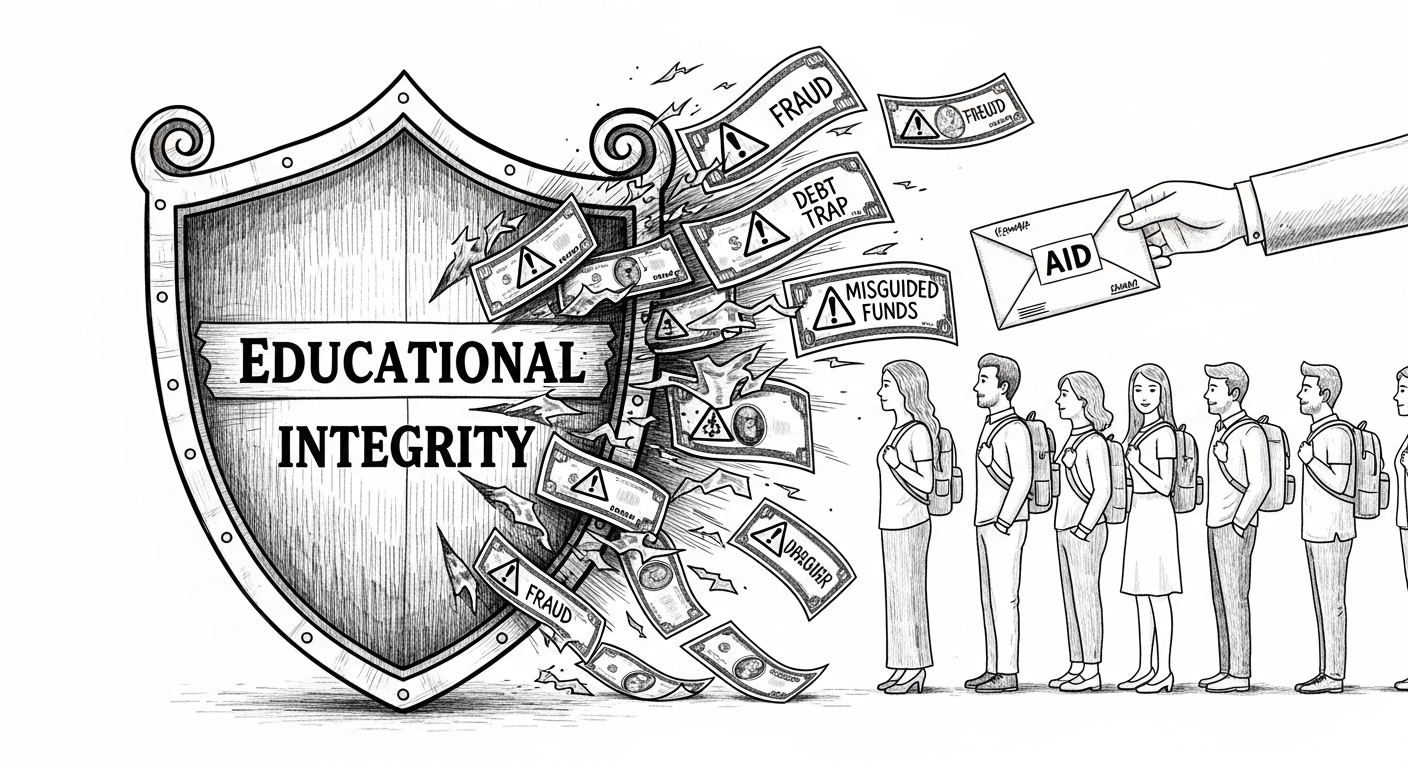
The Trump administration has implemented a new screening system for federal student aid applications, flagging approximately 300,000 fraudulent submissions and blocking $60 million in aid within two weeks.
Jump to The Flipside Perspectives

The Trump administration has launched a significant federal crackdown on student loan fraud, with a newly deployed screening system already identifying hundreds of thousands of fraudulent applications. Officials from the Department of Education revealed that the risk assessment system, activated on April 26, has begun to produce rapid results, preventing millions of dollars from being disbursed to ineligible individuals.

"So we actually think that Ilhan Omar definitely committed immigration fraud against the United States of America." — J.D. Vance, Vice President

The new technology is embedded directly into the Free Application for Federal Student Aid (FAFSA), the primary portal through which millions of Americans apply for Pell Grants and federal loans annually. In the two weeks following its implementation, the system flagged approximately 300,000 applications as fraudulent, effectively blocking $60 million in student aid that officials contend had no legitimate claim. A senior administration official, who confirmed these figures to the Daily Caller, highlighted the advanced capabilities of the technology. "We’re using best in class technology, and we’ve been able to stop a lot of those fraudulent activities that are there," the official stated, emphasizing an enhanced ability to intercept fraudulent activities before any funds are transferred.

The screening tool operates by subjecting every FAFSA submission to a real-time identity verification process immediately upon submission. Applications that trigger a high-risk designation are temporarily halted, requiring applicants to provide government-issued identification, such as a driver’s license, passport, tribal ID, or permanent resident card, before they can proceed to receive federal funds. For the vast majority of legitimate applicants, this process remains imperceptible, with scrutiny focused exclusively on submissions that exhibit red flags.

Colleges and universities are also integral to this expanded anti-fraud initiative. The Department of Education has issued directives requiring institutions nationwide to implement their own fraud screening protocols. Officials have underscored that schools maintain flexibility in determining the specific methods for carrying out these verification processes. The senior official elaborated on this collaborative approach, saying, "We kind of started this entire process around identity verification. We provided institutions flexibility on how they verify identities that they can do online, through Zoom, or in person." The official added, "We continue to work with institutions to provide as much flexibility as they identify identities."

The administration projects that these combined fraud prevention measures will safeguard taxpayers from over $1 billion in losses during the current FAFSA cycle alone. This substantial figure underscores the extent to which the federal student aid system has been exploited. Administration officials attribute the proliferation of fraud to decisions made during the COVID-19 pandemic, arguing that the relaxation of verification requirements created vulnerabilities. This environment, they contend, allowed sophisticated fraud rings, artificial intelligence bots impersonating students, and "ghost students"—fabricated identities created solely to illegally acquire federal funds—to extensively exploit the system.

The student loan crackdown is part of a broader anti-fraud framework that the Trump administration has been actively developing across various federal agencies. The White House established an Anti-Fraud Task Force, operating under the direct leadership of Vice President J.D. Vance, to spearhead these efforts. Concurrently, the Department of Justice has appointed a dedicated assistant attorney general specifically tasked with pursuing fraud cases nationwide.

Investigators acknowledge YouTube personality Nick Shirley for his role in galvanizing this broader anti-fraud push. Shirley previously brought to light nearly a dozen Somali-operated daycare centers in Minnesota that were reportedly collecting government payments without providing actual services to children. Vice President Vance's task force has since broadened its focus to include Democratic Minnesota Representative Ilhan Omar. Vice President Vance has publicly accused Representative Omar of immigration fraud. "So we actually think that Ilhan Omar definitely committed immigration fraud against the United States of America," Vance stated in an interview with conservative commentator Benny Johnson. Vance further disclosed that Stephen Miller, White House deputy chief of staff, has been involved in discussions regarding potential legal avenues to address the matter. "I talked to Stephen Miller about this, actually, recently. We’re trying to look at what the remedies are," Vance said. "That’s the thing that we’re trying to figure out is what are the legal remedies now that we know that she’s committed immigration fraud? How do you go after her? How do you investigate her? How do you actually do the thing? How do you build the case necessary to get some justice for the American people?" Vance continued, asserting that Representative Omar "has been at the center of a lot of the worst fraudsters in the Somali community."

Advertisement

The Flipside: Different Perspectives

Progressive View

While efforts to combat fraud in federal programs are generally supported, it is crucial to examine the broader context and potential implications of such crackdowns. The focus on "bad actors" and "fraud rings" risks oversimplifying the complex socio-economic factors that can lead to misapplications or errors in student aid. For vulnerable populations, navigating the FAFSA process can be challenging, and overly stringent or technologically dependent screening systems could inadvertently create barriers for legitimate students in need of financial assistance. Ensuring that identity verification processes are accessible and do not disproportionately impact marginalized communities is essential.

Moreover, while saving taxpayer money is a stated goal, it is also important to consider the root causes of systemic exploitation. The source mentions that loosened verification requirements during the COVID-19 pandemic opened the door to fraud. This points to a need for robust, well-resourced administrative processes, rather than simply punitive measures. The broader anti-fraud architecture, particularly the politicized accusations against a sitting Congresswoman, raises concerns about the potential for these initiatives to be used for political targeting rather than solely for impartial fraud prevention. A truly equitable approach would balance robust oversight with compassionate support, ensuring that genuine students receive the aid they need without facing undue hurdles, while addressing systemic vulnerabilities through comprehensive policy rather than solely through enforcement.

Conservative View

The Trump administration's aggressive stance on student loan fraud and broader government waste aligns perfectly with conservative principles of fiscal responsibility and limited government. The implementation of advanced screening technology for FAFSA applications is a commendable step towards safeguarding taxpayer dollars from exploitation. Preventing $60 million in fraudulent aid within two weeks and projecting over $1 billion in savings demonstrates a commitment to ensuring that federal programs serve their intended purpose, rather than becoming conduits for fraud rings and bad actors. This initiative highlights the importance of strong oversight and accountability in federal spending, especially given the rapid expansion of aid programs during the pandemic.

Furthermore, the establishment of an Anti-Fraud Task Force under Vice President J.D. Vance, coupled with a dedicated assistant attorney general for fraud cases, signals a serious intent to combat corruption across all federal agencies. This proactive approach ensures that those who attempt to defraud the system are held accountable, reinforcing the rule of law and protecting the integrity of public institutions. The focus on identity verification and the involvement of educational institutions in fraud screening empower individual actors to be responsible stewards of federal resources. This administration’s actions underscore the belief that government’s role is to protect citizens and their resources, not to allow them to be siphoned off by fraudulent schemes, thereby upholding the principles of individual liberty and economic efficiency.

Common Ground

There is broad agreement across the political spectrum that fraud within federal programs is unacceptable and that taxpayer money should be protected from waste and abuse. Both conservatives and progressives can agree on the importance of efficient and secure systems for distributing federal aid, ensuring that funds reach their intended recipients. The implementation of advanced technology to detect and prevent fraudulent applications, such as the new FAFSA screening system, can be seen as a practical, bipartisan solution to a shared problem, provided it is implemented fairly and transparently.

Furthermore, the goal of preventing over $1 billion in losses due to fraud is a significant achievement that benefits all Americans, regardless of political affiliation, by preserving public resources. Both sides can support efforts to improve the integrity of federal programs and hold accountable those who intentionally exploit the system. Discussions around the causes of fraud, including vulnerabilities exposed during crises like the pandemic, offer opportunities for bipartisan cooperation on developing robust, long-term policy solutions that enhance program security without creating undue burdens for legitimate applicants. Focusing on technological improvements and administrative efficiencies to combat fraud can serve as a common objective that transcends ideological divides.

What's your view on this story? Share your thoughts and remember to consider multiple perspectives and being respectful when forming and voicing your opinion. "If you resort to personal attacks, you have already lost the debate..."

Advertisement

Contact Us About This Article

Have a question or comment about this article? We'd love to hear from you.

About Fair Side News

At Fair Side News, we believe in presenting news with perspectives from both sides of the political spectrum. Our goal is to help readers understand different viewpoints and find common ground on important issues.