


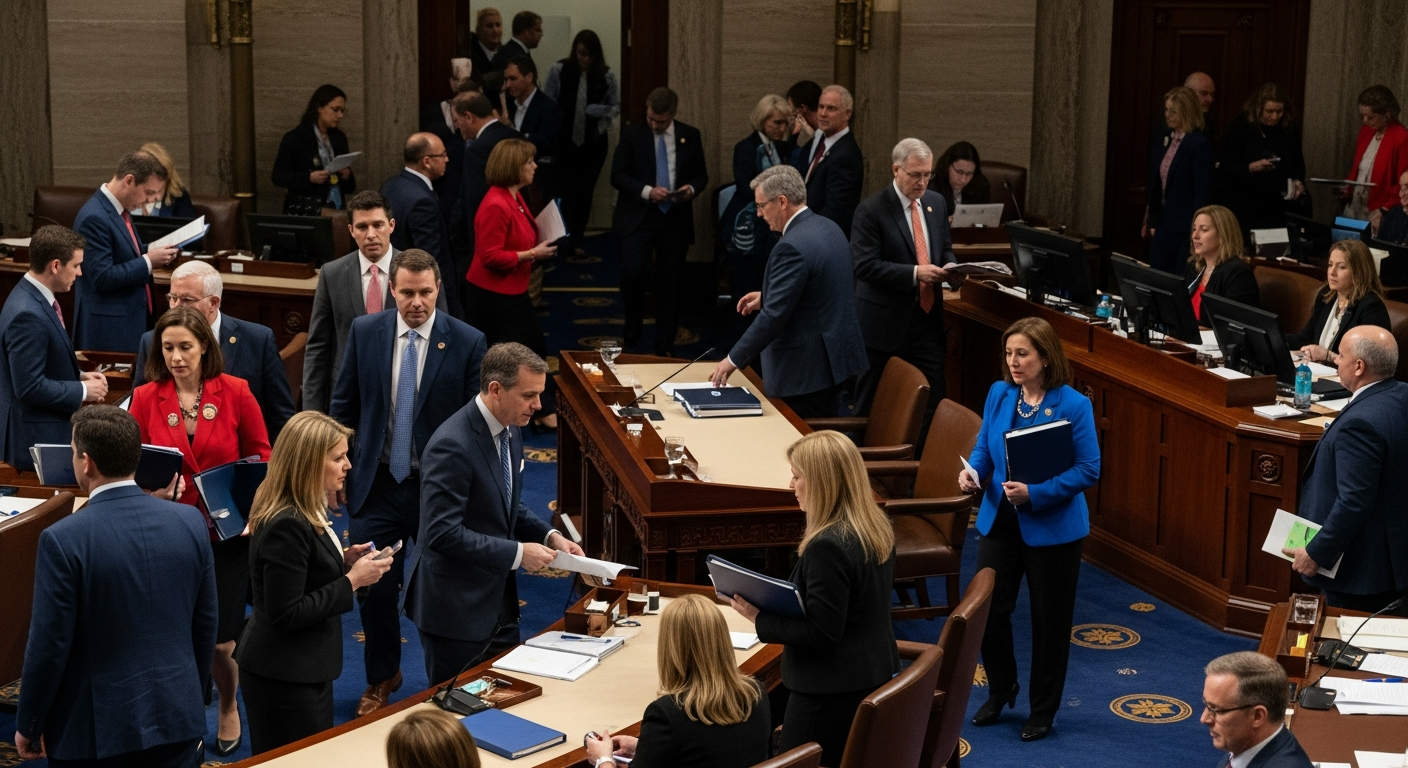
Washington, D.C. — The U.S. Senate on Monday approved 49 of President Donald Trump’s nominees, significantly boosting the administration’s civilian confirmation rate to approximately 60 percent. This mass confirmation, occurring just before the Memorial Day recess, marks the fourth consecutive instance where Senate Republicans have utilized revised procedural rules to push through executive branch appointments. The confirmed personnel will fill roles across 20 different federal job categories, ranging from law enforcement and diplomatic posts to various agency leadership positions.
Among the confirmed nominees were 12 U.S. attorney slots, multiple U.S. marshals, and a contingent of ambassadors cleared for overseas deployment. Personnel slated for roles within federal departments, including Transportation and Energy, also earned their confirmations, filling seats across the expansive federal bureaucracy. Notably, Stevan Pearce received Senate approval as President Trump’s pick to lead the Bureau of Land Management, a prominent individual confirmation within this recent batch.
The path to these confirmations has been shaped by a protracted procedural battle. Throughout the previous year, Senate Democrats frequently employed tactics to slow or halt confirmation votes on numerous nominees. Republicans, spearheaded by arguments against Minority Leader Chuck Schumer of New York, contended that these delays were a deliberate effort to prevent President Trump’s appointees from implementing his agenda.
In response to these perceived obstructions, Senate Republicans invoked the "nuclear option" last year, a procedural maneuver that altered Senate rules. This change reduced the vote threshold required to advance certain nominees from 60 votes to a simple majority. This historical move marked only the fourth time in the Senate’s history that such a procedural change had been implemented. Under these new rules, Republicans confirmed over 400 of President Trump's nominees last year. The current overall confirmation tally for President Trump's second term has now surpassed his first-term numbers, which saw 323 nominees confirmed over a comparable period. It also outpaces the confirmation rate of President Joe Biden's administration, which had 365 nominees confirmed during a similar timeframe.
Concurrently, Senate Republicans are working to pass a separate legislative measure: a $72 billion funding package dedicated to immigration enforcement over the next three and a half years. This package aims to provide funding for U.S. Immigration and Customs Enforcement (ICE) and the United States Border Patrol. Republicans are utilizing the budget reconciliation process to advance this funding, setting June 1 as the target date for its passage. The impending Memorial Day recess has created urgency for GOP leadership to finalize the measure before lawmakers depart Washington.
However, a complication has emerged regarding a specific provision within the same bill. A $1 billion allocation intended to help fund a White House ballroom for President Trump encountered resistance from Senate Parliamentarian Elizabeth MacDonough. MacDonough ruled the ballroom provision out of bounds under the strict rules governing budget reconciliation, determining that it would require 60 votes for passage rather than a simple majority. Her reasoning centered on jurisdictional concerns. As relayed by Senate Democrats, MacDonough found that "A project as complex and large in scale as Trump’s proposed ballroom necessarily involves the coordination of many government agencies which span the jurisdiction of many Senate committees." Democrats further quoted the ruling, stating, "As drafted, the provision inappropriately funds activities outside the jurisdiction of the Judiciary Committee."
Budget reconciliation is a parliamentary mechanism designed to allow certain fiscal legislation to bypass the Senate filibuster, but it is subject to stringent rules regarding what can be included, with the parliamentarian enforcing these guidelines. While MacDonough’s ruling dealt a setback to Republicans concerning the ballroom funding, the party has indicated that it has not abandoned the effort. A Republican leadership aide informed NBC News that revisions to the ballroom language were already in progress prior to MacDonough's Saturday ruling, based on earlier guidance from Senate officials. The Judiciary Committee’s Republican spokesman further confirmed the ongoing efforts, stating to NBC News that "conversations and revisions are continuing, as they have been for days."

