


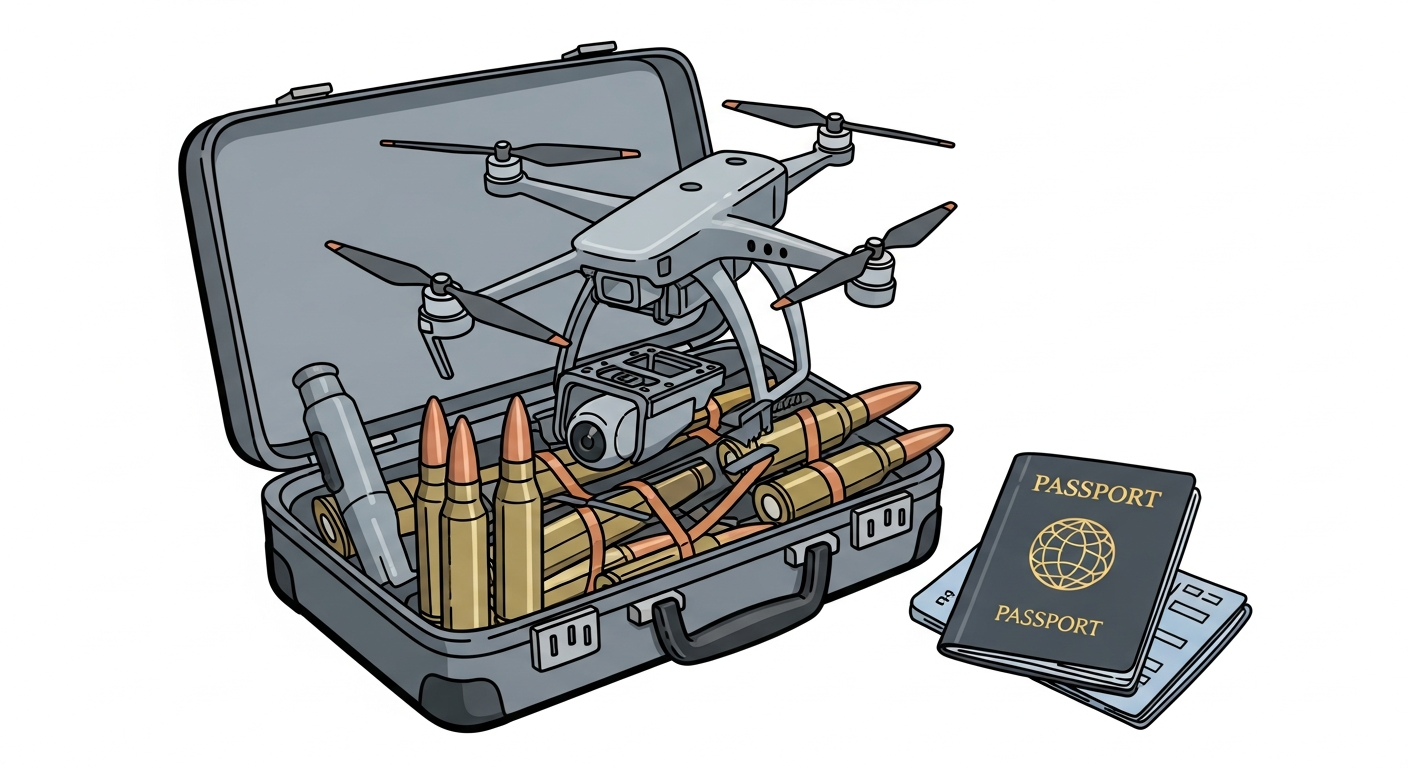
Federal authorities arrested Shamim Mafi, a 44-year-old Iranian national and lawful U.S. permanent resident, at Los Angeles International Airport (LAX) as she was allegedly attempting to board a flight to Istanbul, Turkey. The arrest, confirmed recently, is part of an ongoing investigation into alleged arms brokering activities suspected to be tied to the Iranian government, federal prosecutors announced.
Mafi faces a 68-page criminal complaint that accuses her of orchestrating sales of various military-grade items, including drones, bombs, bomb fuses, and millions of rounds of ammunition manufactured by Iran and allegedly sold to Sudan. She has also been charged with conspiracy to violate the International Emergency Economic Powers Act (IEEPA), a statute that authorizes the President to regulate international commerce after declaring a national emergency in response to any unusual and extraordinary threat to the national security, foreign policy, or economy of the United States. If convicted on these charges, Mafi could face a maximum sentence of 20 years in federal prison.
Prosecutors assert that the alleged transactions required specific U.S. licenses due to their involvement with sanctioned goods and countries. However, Mafi purportedly failed to obtain these necessary approvals. Among the most significant alleged deals detailed in the complaint is a contract valued at over $70.6 million for Iranian-made Mohajer-6 armed drones, which were intended for Sudan’s Ministry of Defense. The Mohajer-6 drone has previously garnered international attention due to its documented use in various battlefields and concerns over its proliferation.
The criminal complaint further alleges that Mafi played a role in facilitating the sale of 55,000 bomb fuses to the Sudanese military. Additional ammunition transactions listed in the federal filing included one deal for 10 million rounds of AK-47 ammunition and another proposed contract for an even larger quantity of 240 million rounds.
Federal investigators have traced the payment routes for these alleged transactions, indicating that funds were routed through Turkey and the United Arab Emirates. An Oman-registered company, Atlas International Business LLC, was reportedly utilized in these financial maneuvers. Prosecutors contend that this complex financial structure was deliberately employed to evade U.S. sanctions restrictions and to conceal the true source and nature of the transactions.
Court records associated with the case also claim that Mafi maintained regular contact with individuals linked to Iranian intelligence. According to the complaint, records obtained through a search warrant revealed approximately 62 bidirectional contacts between Mafi and a phone number associated with an officer from Iran’s Ministry of Intelligence and Security. These contacts reportedly occurred between December 2022 and June 2025. During interviews with U.S. Customs and Border Protection officers and the Federal Bureau of Investigation (FBI), Mafi allegedly acknowledged these communications. The complaint states she told investigators that she was “more useful to them in Iran than in the United States.”
Authorities allege that the comprehensive scheme was conducted from multiple countries, including the United States, Iran, Turkey, Oman, and other undisclosed locations, highlighting the international scope of the alleged activities. Bill Essayli, who confirmed the arrest in a public statement, indicated that Mafi was expected to make her initial court appearance in downtown Los Angeles on Monday. Essayli also emphasized that Mafi is presumed innocent unless proven guilty in court, upholding a fundamental principle of the justice system.
This case unfolds amidst heightened U.S. scrutiny of Iranian international networks. The United States has been closely monitoring activities involving sanctions evasion, weapons transfers, and proxy conflicts across the Middle East and Africa, areas where Iran is often alleged to play a disruptive role. For prosecutors, the core of the allegation is that Mafi leveraged her U.S. residency status and international access to broker prohibited weapons sales, thereby undermining international sanctions regimes designed to curb specific geopolitical activities.

