

Breaking
Sponsor Advertisement
Reported Standoff Over FISA 702 Reauthorization
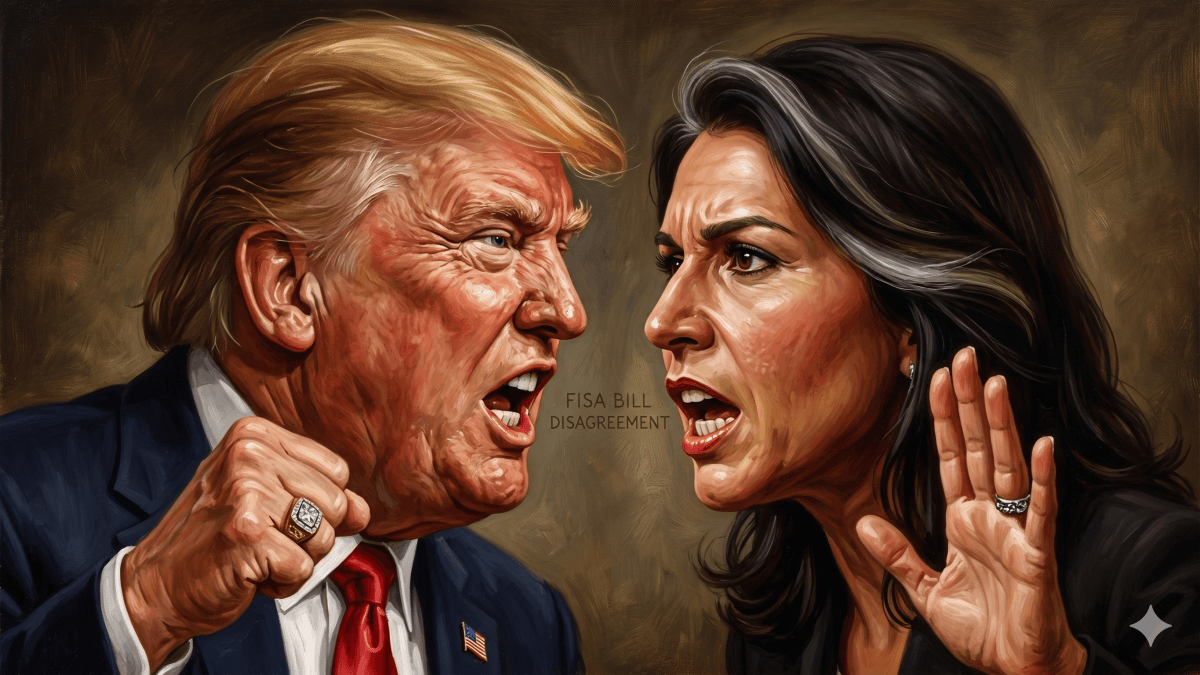
AI-generated image for: Reported Standoff Over FISA 702 Reauthorization

Reported Standoff Over FISA 702 Reauthorization

A private White House meeting in February reportedly saw a disagreement between President Donald Trump and Director of National Intelligence Tulsi Gabbard regarding the reauthorization of Section 702 of the Foreign Intelligence Surveillance Act.
Jump to The Flipside Perspectives

A reported private meeting in February between President Donald Trump and his Director of National Intelligence (DNI), Tulsi Gabbard, produced an unusual point of friction over the reauthorization of Section 702 of the Foreign Intelligence Surveillance Act (FISA). The discussion, held at the White House, centered on the future of the legal authority that permits federal intelligence agencies to intercept foreign communications, sometimes including those of American citizens, without a warrant.

"My prior concerns about FISA were based on insufficient protections for civil liberties, particularly regarding the FBI’s misuse of warrantless search powers on American citizens." — Tulsi Gabbard, Director of National Intelligence

According to two anonymous sources cited by Politico’s Morning Cyber newsletter, the conversation failed to yield an agreement. President Trump reportedly maintained a firm stance, advocating for a clean extension of Section 702, devoid of any new oversight mechanisms or reform language. DNI Gabbard, in turn, reportedly pushed back against this approach, though the precise nature of her objections was not detailed in the reports.

The White House, however, publicly denied any divergence in views. A White House official told the Daily Caller News Foundation, “President Trump’s entire exceptional national security team is in lockstep with the President in advancing his efforts to achieve a clean reauthorization of FISA 702.” Gabbard’s office did not respond to requests for comment regarding the reported meeting.

This reported friction is notable given DNI Gabbard’s past public positions on FISA. As a Democratic congresswoman representing Hawaii, Gabbard was a vocal critic of the surveillance program. In 2020, she co-sponsored legislation alongside Republican Rep. Thomas Massie of Kentucky aimed at dismantling the federal government’s bulk data collection initiatives. Her stance was clearly articulated in her public writings from that period. She stated in 2020, “Unfortunately Congress just passed a bill allowing continuation of intel/law enforcement agencies to infringe on your civil liberties.” She added, “Patriot Act & Foreign Intelligence Surveillance Act (FISA) needed real reforms to prevent these constitutional abuses. Congress failed to do this.” Gabbard had also characterized the program as an “overreach” of congressional authority.

However, her perspective shifted following her Senate confirmation as Director of National Intelligence. In 2025, Punchbowl News reported that Gabbard began describing Section 702 as “crucial” and argued it “must be safeguarded to protect our national while ensuring the civil liberties of Americans.” When asked about this apparent change, Gabbard offered a distinction. She told ABC News, “My prior concerns about FISA were based on insufficient protections for civil liberties, particularly regarding the FBI’s misuse of warrantless search powers on American citizens.” This explanation suggests her current focus is on refining the implementation of the program rather than outright opposition to its existence.

President Trump has also publicly championed a clean reauthorization of Section 702. Posting on Truth Social on Wednesday, the president underscored his support, asserting that amendments would create unnecessary obstacles to national security operations. “Our Military Patriots desperately need FISA 702, and it is one of the reasons we have had such tremendous SUCCESS on the battlefield,” President Trump wrote. He further indicated a personal willingness to compromise for its extension, stating he would be “willing to risk the giving up of [his] Rights and Privileges” to secure the reauthorization.

The push for a clean extension faces significant resistance within Congress. A bipartisan coalition of senators has voiced concerns about the implications of a broad reauthorization, particularly in an era of rapidly advancing artificial intelligence. These lawmakers warn that AI technologies could enable new avenues for mass collection and analysis of American citizens’ private information. Senator Mike Lee, a Republican from Utah, has introduced legislation designed to establish new safeguards, irrespective of the outcome of the broader FISA debate. His bill would mandate federal agencies to secure a warrant before acquiring citizens’ personal data or accessing their private communications.

On the House side, Speaker Mike Johnson has sought to bring the reauthorization bill to a vote, facing sustained opposition from within his own party. As of recent reporting, negotiations between the White House and Republican holdouts were ongoing, with no final agreement reached. While President Trump's desired clean extension may ultimately clear Congress, the level of internal and external resistance it has encountered, including from within his own administration, remains a prominent aspect of the debate.

Advertisement

The Flipside: Different Perspectives

Progressive View

Progressives emphasize the protection of civil liberties, individual privacy, and the prevention of government overreach. From this viewpoint, Section 702 of FISA, particularly its potential for "backdoor searches" of American citizens' data without a warrant, represents a significant threat to constitutional rights. The ability of intelligence agencies to collect and analyze vast amounts of data, especially with the advancements in artificial intelligence, raises alarms about mass surveillance and the erosion of privacy. Progressives argue that while national security is important, it should not come at the expense of fundamental freedoms. They point to historical instances of surveillance abuse and underscore the need for stringent oversight, independent review, and clear warrant requirements for any search involving U.S. persons. DNI Gabbard's prior stance as a congresswoman, criticizing the "constitutional abuses" and "overreach" of FISA, resonates with progressive concerns. Her current explanation, focusing on "insufficient protections for civil liberties" and "FBI’s misuse," highlights the ongoing demand for robust reforms to ensure accountability and prevent the targeting or incidental collection of American communications without proper judicial authorization.

Conservative View

Conservatives generally prioritize national security and effective intelligence gathering to protect the homeland and U.S. interests abroad. From this perspective, Section 702 of FISA is viewed as an indispensable tool for intercepting communications of foreign adversaries, terrorists, and spies operating overseas, which is crucial for preventing attacks and maintaining global stability. President Trump's call for a "clean extension" without new amendments aligns with the belief that adding more oversight mechanisms could unduly burden intelligence agencies, slow down critical operations, and potentially create dangerous gaps in national defense. Proponents argue that the existing framework provides sufficient safeguards, and that the effectiveness of the program should not be compromised by reforms that could weaken its operational capabilities. They emphasize that the primary target of Section 702 is non-U.S. persons located outside the United States, and that incidental collection of American communications is a necessary byproduct of vital foreign intelligence collection, not an intentional targeting of citizens. However, a segment of conservatives, like Senator Mike Lee, also champions individual liberty and privacy, expressing concerns about potential government overreach and the need for warrants, particularly when U.S. citizens' data is involved, even if incidentally collected. This highlights an internal tension within conservative thought between robust national security and constitutional protections.

Common Ground

Despite differing approaches, there are genuine areas of agreement regarding FISA Section 702. Both conservatives and progressives acknowledge the necessity of effective intelligence tools to safeguard national security, counter terrorism, and protect against foreign adversaries. There is a shared understanding that the United States needs robust capabilities to gather intelligence on threats originating from abroad. Simultaneously, there is bipartisan recognition of the importance of protecting the civil liberties and privacy of American citizens. Concerns about potential government overreach, the misuse of surveillance powers, and the impact of rapidly advancing technology like artificial intelligence on individual data are not exclusive to one political ideology. This common concern for both national security effectiveness and civil liberty protection creates an opportunity for constructive dialogue. Practical bipartisan approaches could include exploring enhanced transparency measures, strengthening the FISA Court's oversight role, and implementing clearer protocols for when and how U.S. person data can be accessed, potentially through warrant requirements as proposed by Senator Lee, without unduly hindering critical foreign intelligence collection.

What's your view on this story? Share your thoughts and remember to consider multiple perspectives and being respectful when forming and voicing your opinion. "If you resort to personal attacks, you have already lost the debate..."

Advertisement

Contact Us About This Article

Have a question or comment about this article? We'd love to hear from you.

About Fair Side News

At Fair Side News, we believe in presenting news with perspectives from both sides of the political spectrum. Our goal is to help readers understand different viewpoints and find common ground on important issues.