



Ron Smith had been thinking about this problem for a long time.
Not weeks. Not months. Decades. Every enterprise software project he had worked on, and there had been many, spanning ColdFusion and PHP and Python and financial middleware for some of the largest institutions in the country, started the same way. Weeks of setup. Compliance infrastructure. AI wiring. Configuration. All of it before a single line of actual business logic got written.
"I always said somebody needed to build a language that just knew this stuff already," Ron says. "Knew the compliance rules for healthcare. Knew what a suspicious financial transaction looked like. Knew what to do when AI wasn't sure about something. I'd been saying it for years."
The problem was that building a programming language alone was, until recently, essentially impossible. The kind of work that goes into designing a grammar, writing a compiler, specifying service appendices and query languages and sector profiles, that was the work of teams. University research groups. Well-funded companies with engineering departments.
Then came AI.
"I'd always wanted to do this," Ron says simply. "And now I could."
What started as a long-held idea became something real on an ordinary morning at a Dunkin' Donuts drive-thru in Charlotte. Ron was waiting in line, thinking through a problem he had been turning over for years, and suddenly the structure of it clicked. He started writing on his phone. The core concept of what would become Mohio, the idea that compliance and AI reasoning shouldn't be things you add to a program but things the language itself understands, took shape between the order window and the pickup window.
Later that same day, Ron's car broke down on Interstate 77. Waiting for a tow truck on the side of the highway, he kept writing.
"I wasn't going anywhere," he laughs. "So I just kept going."
By the time he got home, he had the foundation of something genuinely new.
"In healthcare or finance, the uncertain case isn't an edge case, It's often the most important case..." ~Ron Smith, Founder and Creator of Mohio
Mohio, pronounced moh-hee-oh from the Māori word for "to understand," is a programming language with an unusual claim at its center. It is the first language where artificial intelligence reasoning is built directly into the grammar. Not imported as a library. Not bolted on through an external service. Part of the language itself, understood by the compiler, enforced by the runtime.
In practice, that means something specific. When a developer writes an AI decision block in Mohio, the language requires them to define what happens when the AI isn't confident enough to act. Forget that definition and the program won't build. Not a warning. Not a suggestion. The compiler refuses.
"In healthcare or finance, the uncertain case isn't an edge case," Ron explains. "It's often the most important case. A clinical AI that guesses when it shouldn't is dangerous. A fraud system that silently fails is worse than no fraud system at all. The language makes you answer for that before you ship."
Every AI decision in Mohio also writes an automatic audit record. Inputs, result, confidence score, model, timestamp. In regulated industries, that record is a legal requirement. In Mohio, it's not possible to skip.
The compliance story runs even deeper. A single declaration, sector: financial or sector: healthcare, activates an entire framework of institutional knowledge that Ron spent considerable time researching and encoding. The language already knows what a medical record number is. It already knows that patient data must be retained for six years under federal law. It already knows that a cash transaction over ten thousand dollars has reporting requirements. None of that has to be configured or wired or researched by the developer building on top of it.
One word. Decades of regulatory knowledge. Automatically active.
"I want to be clear that this isn't replacing lawyers or compliance teams," Ron says. "The language activates technical enforcement controls. The legal work is still legal work. But the developer stops fighting the compliance requirements and starts building the actual product."
The timeline from that Dunkin' drive-thru to a working compiler is the part that tends to stop people cold. March 23rd, 2026, the idea crystallized. Thirteen days later, the compiler was running real code. By May, 153 of 153 grammar tests were passing and the language was serving live web applications.
None of that would have been possible without AI as a development partner. Ron is clear about this and sees no reason to be otherwise.
"One person doing this alone, the traditional way, would have taken years," he says. "Maybe longer. Maybe never. What AI changed wasn't just the speed. It changed what was possible. We built something novel. Something that genuinely didn't exist before. And we built it as one person and one AI working together. That's the real story here."
The first public demonstration of that story is not a compliance dashboard or a fraud detection system, though Mohio handles both. It is a text adventure.
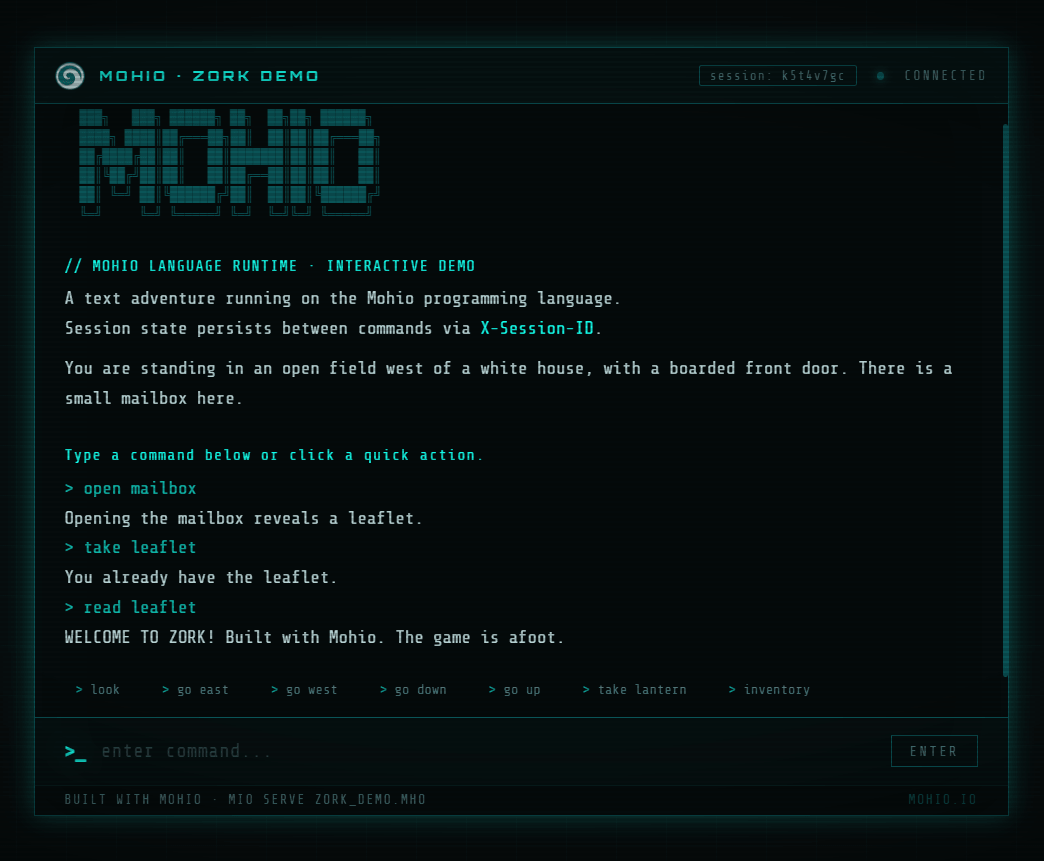
Zork, the pioneering 1977 computer game that helped define interactive fiction, has been rebuilt in Mohio and deployed publicly at zork.mohio.io. Players type commands. The game responds. Players type commands. The game responds. The world remembers where you've been and what you're carrying. And when you phrase something in an unexpected way, the game tries to figure out what you meant rather than simply giving up.
The choice of Zork as the first demo was deliberate.
"I wanted something anyone could experience without knowing anything about compliance or AI or programming languages," Ron says. "You just play. But if you look at the footer, Built with Mohio, mio serve zork_demo.mho, that's a real web application. Running on a language that didn't exist sixty days ago."
Early reaction from developers has ranged from curiosity to outright skepticism. Ron understands it. The phrase "I built a programming language" carries a lot of history on developer forums, most of it pointing toward projects that never got past a handful of keywords and a GitHub repo with three stars.
"The demo is the answer to that skepticism," he says. "Go play it. It's live right now. Then tell me it isn't real."
Mohio is open core under the Apache 2.0 license. The language and compiler are free. The business model Ron is building around it involves certified sector profiles for regulated industries, a hosted runtime for teams who don't want to manage infrastructure, and eventually a visual builder that generates Mohio code without writing a single line directly.
A Sector Pioneer Program is currently accepting applications from financial and healthcare developers who want early access before the public launch. The window, Ron says, is genuinely narrow.
"Six to twelve months," he says. "We're in month two. The people who show up now are the ones who get to say they were here first."
For now, there is a text adventure running at zork.mohio.io, built on a language conceived at a drive-thru window and refined on the side of a highway, by one developer and one AI, doing something that was impossible until it wasn't.
What visitors see at zork.mohio.io is a simple, playable text adventure. What is running underneath it is another matter entirely. Every command a player types exercises the same foundational capabilities that would power a fraud detection system at a bank or a patient intake workflow at a hospital. The AI is reasoning in real time. The game remembers. And a patent-pending system is continuously learning from every interaction, getting smarter and more efficient the longer it runs. Smith chose a text adventure as the first public demo deliberately. The simplicity on the surface is the point. Anyone can play it. Not everyone will immediately recognize what it took to make it possible.
Ron added the caveat that the Zork demo is being constantly updated in real-time. So, expect temporary glitches as the team experiments.
The game, as the leaflet inside the mailbox says, is afoot.
Try the demo at zork.mohio.io. Learn more at mohio.io. The Mohio project is open core at github.com/countart/mohio. Apply for the Sector Pioneer Program at hello@mohio.io.

