

Breaking
Sponsor Advertisement
Trump AI Image Sparks Debate, Graham Defends Intent
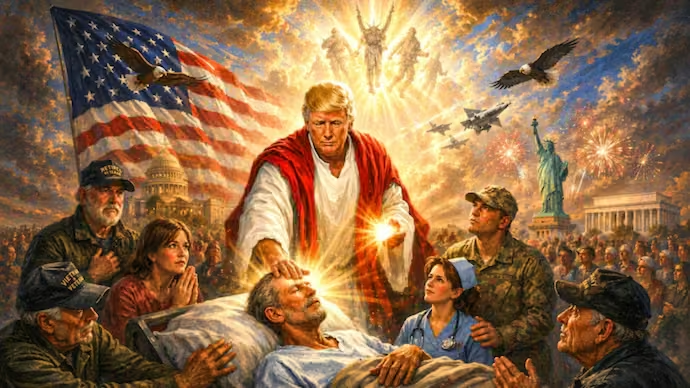
In a now deleted post, Trump appeared draped in what looked like robes, surrounded by heavenly light. (Photo: X)

Trump AI Image Sparks Debate, Graham Defends Intent

President Donald Trump reshared an AI-generated image that critics interpreted as depicting him as Jesus Christ, a claim he and evangelical leader Reverend Franklin Graham both rejected. Trump stated he saw the image as depicting a doctor and removed the post after concerns arose.
Jump to The Flipside Perspectives

Washington D.C. – President Donald Trump ignited a media controversy this week after resharing an AI-generated image on social media that critics widely interpreted as portraying him as Jesus Christ. The image, which depicted President Trump in a white robe with a red sash, reaching out towards an ailing American, was removed from his account on April 13, 2026, following escalating public criticism. Both President Trump and prominent evangelical leader Reverend Franklin Graham have publicly refuted the interpretation that the image was intended to depict the President as a religious figure.

"I do not believe President Trump would knowingly depict himself as Jesus Christ — that would certainly be inappropriate. I’m thankful the President has made it very clear that this was not at all what he thought the AI-generated image was representing — he thought it was a doctor helping someone, and when he learned of the concerns, he immediately removed the post." — Reverend Franklin Graham, Evangelical Leader

The image at the center of the debate featured President Trump with his hand extended towards a person lying on a bed, accompanied by a nurse and a uniformed military servicemember. In the background, an eagle soared alongside fighter aircraft, with the Statue of Liberty and an American flag completing the scene. Almost immediately after President Trump reshared the image, online commentators and media outlets began drawing parallels to religious iconography, suggesting the President was casting himself in a divine role.

Responding to the backlash, President Trump quickly pushed back against the claims, stating his intention was entirely different. "Well, it wasn’t depiction. It was me. I did post it, and I thought it was me as a doctor, and had to do with Red Cross; there’s a Red Cross worker there, which we support,” President Trump told reporters. He criticized media outlets for their interpretation, adding, "Only the fake news could come up with that one. So I just heard about it, and I said, ‘How do they come up with that?’ It’s supposed to be me as a doctor, making people better.” The post was subsequently removed from his social media account.

Amidst the ongoing debate, Reverend Franklin Graham, son of the late Reverend Billy Graham, offered a measured defense of President Trump, addressing inquiries from his followers. Graham articulated his position clearly, stating, "I do not believe President Trump would knowingly depict himself as Jesus Christ — that would certainly be inappropriate. I’m thankful the President has made it very clear that this was not at all what he thought the AI-generated image was representing — he thought it was a doctor helping someone, and when he learned of the concerns, he immediately removed the post.”

Graham further elaborated on his reasoning by analyzing the visual elements within the image. He pointed out the absence of traditional religious symbols such as halos, crosses, or scripture, arguing these omissions indicated a non-religious intent. Instead, he highlighted the presence of "a flag, soldiers, a nurse, fighter planes, eagles, the Statue of Liberty," concluding that the controversy was "a lot to do about nothing." He suggested that President Trump’s "enemies are always foaming at the mouth at any possible opportunity to make him look bad."

The evangelical leader also drew attention to a second image President Trump had reshared on Truth Social during the same week. This image depicted Jesus standing beside President Trump, with a hand resting on the President’s shoulder. Graham expressed approval of this particular illustration, stating, "And the illustration from someone else he reposted on Truth Social yesterday, I must say that I like the fact that this is a picture of Jesus whispering in his ear, or at least his hand on his shoulder, guiding him. We all need that — we all need to be listening to Jesus.” President Trump himself appended commentary to this second image, writing, "The Radical Left Lunatics might not like this, but I think it is quite nice!!!" The meme included a caption suggesting divine intervention in current events, stating, "I was never a very religious man … but doesn’t it seem, with all these satanic, demonic, child sacrificing [sic] monsters being exposed … that God might be playing his Trump card!"

Graham reminded the public that President Trump did not create either of the images himself, merely reposted them. "Again, I think there is an attempt to spin this into something that it isn’t. Remember, President Trump didn’t draw this, he didn’t create it, he reposted it on his social media because he thought it was nice — I would have to agree,” Graham noted. He concluded his statement by praising President Trump's record on faith, calling him "the most pro-Christian, pro-life president in my lifetime" and expressing a desire for President Trump and Pope Leo XIV to meet, hoping the Pontiff would acknowledge the administration's efforts in defending religious freedom globally.

This episode unfolded against a backdrop of a separate and developing tension between President Trump and Pope Leo XIV. President Trump had recently publicly criticized the pontiff, labeling him as "WEAK on Crime, and terrible for Foreign Policy." The series of social media posts and subsequent reactions underscore the ongoing interplay between political communication, religious interpretation, and media scrutiny in the current public discourse.

Advertisement

The Flipside: Different Perspectives

Progressive View

Progressive perspectives on President Trump's reshared AI image often raise concerns about the blurring of lines between political leadership and religious iconography, irrespective of stated intent. While acknowledging President Trump's denial, the initial act of sharing such an image, particularly one that could be interpreted as a messianic figure, is seen as problematic. Progressives emphasize the importance of maintaining a clear separation of church and state, and the use of religious symbolism by a sitting president can be perceived as an attempt to leverage faith for political gain or to cultivate a cult of personality.

From this viewpoint, the public's reaction and media scrutiny are not "fake news" but rather a necessary function of a free press holding powerful figures accountable for the messages they convey. The potential impact of such imagery on a diverse populace, including those of different faiths or no faith, is a key consideration. While President Trump's eventual removal of the post is noted, the initial decision to share it and the subsequent explanation are often viewed critically, suggesting a lack of sensitivity or judgment regarding public perception. The later sharing of an image depicting Jesus with President Trump further compounds these concerns, seen by some as an explicit attempt to conflate religious authority with political power, potentially alienating segments of the population and undermining democratic norms.

Conservative View

From a conservative perspective, the controversy surrounding President Trump's reshared AI image is largely viewed through the lens of media bias and an overzealous attempt to criticize the President. Conservatives often emphasize individual liberty, including the freedom of expression and the right to share content on personal social media. The President's explanation that he saw himself as a "doctor making people better" aligns with a view of public service and a desire to improve the nation, rather than a blasphemous self-depiction. Reverend Franklin Graham's defense resonates strongly, as it highlights the absence of religious iconography in the image itself and attributes the criticism to political enemies seeking to undermine the President.

Many conservatives see this as another instance where President Trump is held to a different, more scrutinizing standard by certain media outlets, which they believe often misinterpret or sensationalize his actions. They would argue that the immediate removal of the post by President Trump after concerns were raised demonstrates responsiveness, and his supporters would likely accept his explanation at face value. Furthermore, Graham's praise for President Trump as "the most pro-Christian, pro-life president in my lifetime" reinforces the idea among conservatives that President Trump is a champion of their values, making any accusations of sacrilege seem unfounded or politically motivated. The broader context of President Trump's support for religious freedom and Christian values is paramount in this viewpoint.

Common Ground

Despite differing interpretations of President Trump's social media activity, areas of common ground can be identified regarding the broader implications for public discourse and leadership. All sides can agree on the importance of clear communication from public figures to avoid misinterpretation, especially in the age of rapidly disseminated digital content. The power of imagery, particularly AI-generated content, to convey unintended messages is a shared challenge that leaders and the public must navigate.

There is also a shared understanding that social media platforms are potent tools for communication, capable of both fostering connection and sparking controversy. Regardless of political affiliation, citizens generally expect leaders to be mindful of how their actions and shared content are perceived across diverse populations. Constructively, this incident highlights the need for media literacy for both content creators and consumers, emphasizing critical thinking when encountering potentially ambiguous or symbolic imagery online. Ultimately, fostering an environment where discussions about public figures' actions are grounded in factual reporting and open dialogue, rather than immediate condemnation or unquestioning defense, serves the interests of a healthy democracy.

What's your view on this story? Share your thoughts and remember to consider multiple perspectives and being respectful when forming and voicing your opinion. "If you resort to personal attacks, you have already lost the debate..."

Advertisement

Contact Us About This Article

Have a question or comment about this article? We'd love to hear from you.

About Fair Side News

At Fair Side News, we believe in presenting news with perspectives from both sides of the political spectrum. Our goal is to help readers understand different viewpoints and find common ground on important issues.