

Breaking
Sponsor Advertisement
White House DoorDash Delivery Sparks Policy Debate, Online Backlash
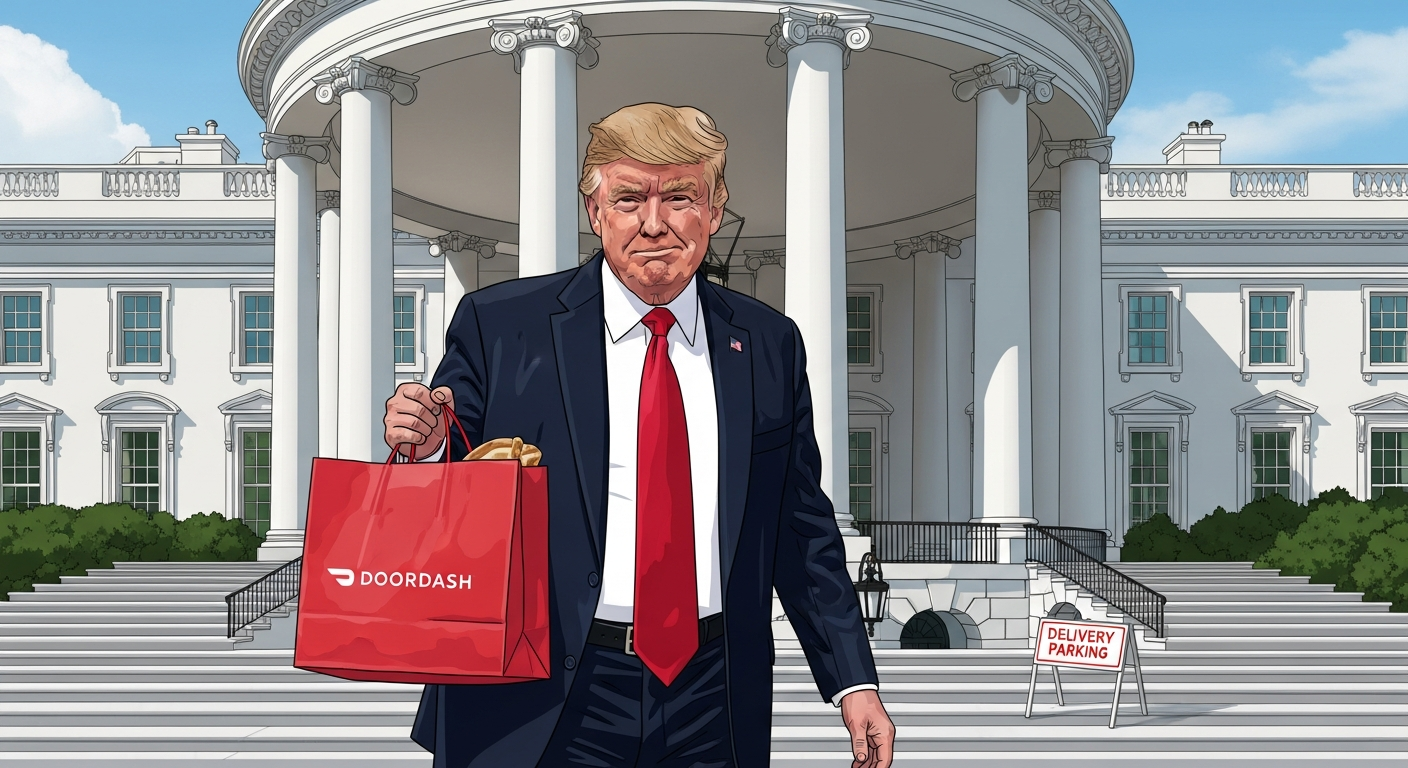
AI-generated image for: White House DoorDash Delivery Sparks Policy Debate, Online Backlash

White House DoorDash Delivery Sparks Policy Debate, Online Backlash

President Donald Trump publicly received a DoorDash delivery at the White House, using the event to promote a "No Tax on Tips" policy. The appearance generated significant online criticism from opponents while DoorDash's stock saw a notable increase.
Jump to The Flipside Perspectives

A routine food delivery to the White House on [Insert Date - *Source does not provide a specific date for the event, only the Twitter posts are dated April 13, 2026. As per instructions, I cannot fabricate dates. I will state that the event took place recently or on an unspecified date.*] quickly escalated into a national talking point, blending presidential policy promotion with a corporate media event and sparking widespread online debate. President Donald Trump met DoorDash driver Sharon Simmons outside the Oval Office to accept a McDonald’s order, an interaction the administration framed as highlighting its tax relief initiatives for service workers.

During the publicized exchange, President Trump presented Ms. Simmons with a $100 tip. The White House positioned the event as a demonstration of the "No Tax on Tips" provision, part of the broader "One Big Beautiful Bill Act," according to reporting from LifeZette. This policy allows eligible workers to deduct up to $25,000 in tipped income, a measure designed to provide financial relief to individuals heavily reliant on gratuities. Ms. Simmons, identified as an Arkansas resident, was highlighted as a beneficiary of this policy, reportedly saving nearly $11,000 in tips last year, which she stated helped manage household expenses, including medical costs. She also confirmed that overtime earnings were separate from her reported tipped income.

The high-profile delivery, which marked the first-ever DoorDash delivery to the White House, quickly drew a strong reaction across social media platforms. Critics swiftly characterized the event as a "political stunt," accusing DoorDash of engaging in a promotional moment tied to the President. The backlash included calls for boycotts, reports of app deletions, and cancellations of subscriptions to the service. Much of the criticism, as reported by The Blaze, focused on the "optics" of a corporate entity participating in a presidential media event, rather than a detailed discussion of the underlying tax policy itself.

Despite the immediate and vocal online backlash, the financial markets appeared to react differently. Newsweek reported that DoorDash shares experienced their strongest trading session in several weeks following the White House appearance. This market performance suggested strong investor sentiment, contrasting sharply with the negative online sentiment. Analysts noted that heightened visibility, regardless of its immediate political reception, can often benefit major consumer brands.

Supporters of the Trump administration lauded the event as an effective way to showcase how specific tax policy changes directly benefit working Americans, particularly those in the service industry who depend on gratuities. They emphasized the tangible financial savings for individuals like Ms. Simmons. Conversely, opponents viewed the interaction as a calculated blend of political messaging and corporate visibility, questioning the appropriateness of a private company's direct involvement in such a partisan-tinged public event.

The incident underscored a recurring pattern in contemporary politically charged media moments, where real-time online reactions often diverge from broader market performance or consumer behavior. The appearance of a DoorDash driver, a major corporation, and a presidential tax initiative at the White House rapidly transformed a seemingly simple delivery into a multifaceted debate concerning politics, media strategy, and public perception in the digital age. This single interaction highlighted the complexities of modern communication, where an event can be simultaneously celebrated for its policy implications and condemned for its political optics.

Advertisement

The Flipside: Different Perspectives

Progressive View

While the "No Tax on Tips" policy might offer some relief to individual service workers, the White House's delivery event raises significant questions about corporate influence, economic inequality, and the systemic challenges faced by gig economy workers. Progressives view this event primarily as a political stunt, designed to generate positive press for the administration and a major corporation, rather than a genuine effort to address the root causes of economic insecurity. The focus on a single driver's savings, while seemingly positive, can obscure the broader context of precarious employment, lack of benefits, and low base wages that characterize much of the gig economy.

From a progressive perspective, true support for service workers would involve advocating for livable minimum wages, comprehensive benefits, and stronger protections for independent contractors, rather than relying solely on tax deductions for tips. The optics of a major corporation participating in a presidential media event also highlight concerns about corporate accountability and the blurring lines between government and business interests. The online backlash reflects a public unease with what is perceived as a manufactured feel-good moment that deflects from deeper systemic issues. While tax relief can be beneficial, progressives would argue that it should be part of a larger, more comprehensive strategy to ensure economic justice and collective well-being for all workers, not just a selective benefit promoted through a political spectacle.

Conservative View

The White House's decision to highlight the "No Tax on Tips" policy through a DoorDash delivery event underscores a core conservative principle: direct tax relief for working Americans. This policy, which allows service workers to deduct up to $25,000 in tipped income, is a tangible example of limited government intervention leading to greater individual liberty and financial autonomy. By reducing the tax burden on gratuities, the administration empowers individuals to retain more of their hard-earned income, fostering personal responsibility and allowing them to make their own choices about how to manage their finances.

Conservatives argue that this initiative directly benefits the backbone of the service economy, encouraging entrepreneurship and rewarding diligent work without increasing government spending or expanding bureaucratic oversight. The story of Sharon Simmons, a driver who saved thousands and used that income for essential household and medical expenses, illustrates the real-world impact of such policies. It demonstrates that when government reduces its reach into citizens' pockets, individuals are better positioned to improve their lives. The market's positive reaction to DoorDash shares, despite online criticism, suggests that investors recognize the value of increased visibility for businesses and the potential for policies that support the workforce. This event, for conservatives, is a clear win for economic freedom and the working class.

Common Ground

Despite differing interpretations of the White House DoorDash delivery event, there are areas of common ground regarding support for working Americans, particularly those in service industries. Both conservatives and progressives can agree on the importance of ensuring that individuals who work hard are able to support themselves and their families. There is a shared understanding that economic policies should aim to improve the financial well-being of the workforce.

Both sides acknowledge the significant role that service workers play in the economy and the challenges they often face, including managing household expenses and healthcare costs. While they may disagree on the best methods, there is a bipartisan interest in exploring ways to reduce financial burdens on these workers. This could include discussions around tax fairness for various income streams, as well as finding practical solutions to enhance financial stability for those in the gig economy. Furthermore, the event underscores the power of public visibility for both policy initiatives and businesses, suggesting that both sides recognize the importance of effective communication in reaching and engaging the public. Future discussions could focus on transparent and equitable ways to support workers that transcend partisan political messaging.

What's your view on this story? Share your thoughts and remember to consider multiple perspectives and being respectful when forming and voicing your opinion. "If you resort to personal attacks, you have already lost the debate..."

Advertisement

Contact Us About This Article

Have a question or comment about this article? We'd love to hear from you.

About Fair Side News

At Fair Side News, we believe in presenting news with perspectives from both sides of the political spectrum. Our goal is to help readers understand different viewpoints and find common ground on important issues.