

Breaking
Sponsor Advertisement
Ocasio-Cortez Delivers Political Speech at Historic Ebenezer Church
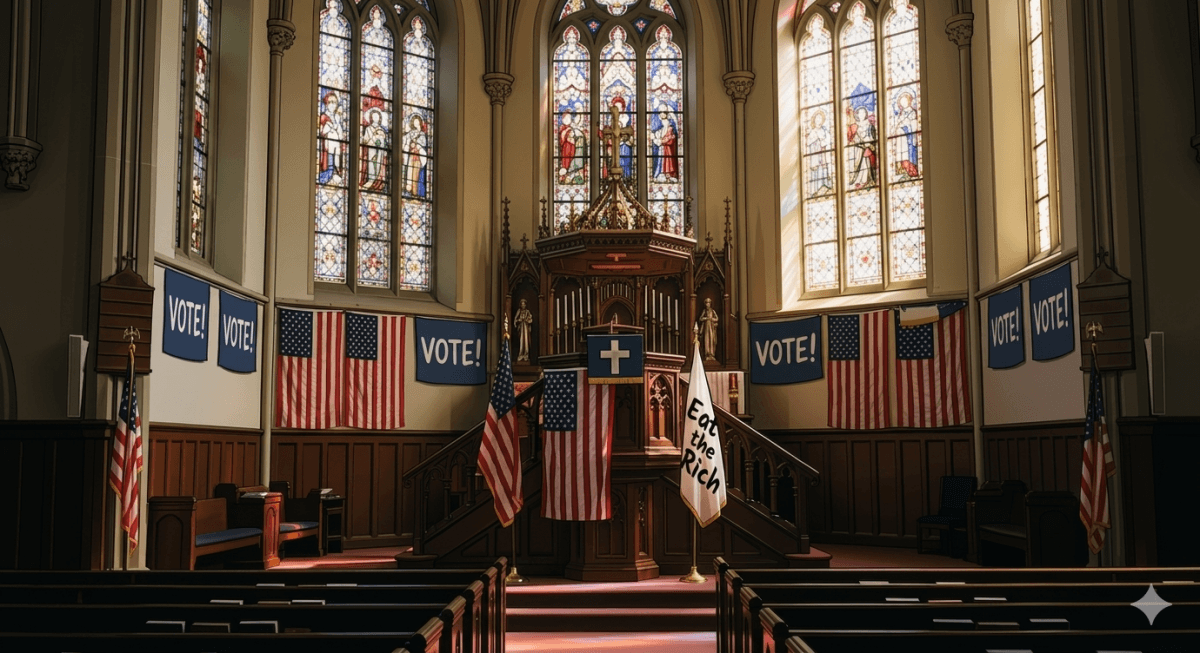
AI-generated image for: Ocasio-Cortez Delivers Political Speech at Historic Ebenezer Church

Ocasio-Cortez Delivers Political Speech at Historic Ebenezer Church

Representative Alexandria Ocasio-Cortez delivered a politically charged address during a Mother's Day worship service at Atlanta's Ebenezer Baptist Church, referencing a recent Supreme Court ruling on the Voting Rights Act and making claims about state redistricting efforts.
Jump to The Flipside Perspectives

On Mother's Day, May 10, 2026, Representative Alexandria Ocasio-Cortez (D-NY) delivered a nearly five-minute address during a Sunday morning worship service at the historic Ebenezer Baptist Church in Atlanta, Georgia, sparking national discussion regarding the politicization of religious institutions and the accuracy of her claims about recent voting rights developments. The congresswoman's remarks centered on the Supreme Court's recent decision concerning the Voting Rights Act and state-level redistricting.

"I don’t take lightly the peril that we are facing just one week after the Voting Rights Act was gutted." — Rep. Alexandria Ocasio-Cortez (D-NY)

Ebenezer Baptist Church holds significant historical weight, having served as the spiritual home and platform for Dr. Martin Luther King Jr., who co-pastored the congregation from 1960 until his assassination in 1968. Today, its Senior Pastor is Senator Raphael Warnock (D-GA), who uniquely balances leadership of a storied congregation with service in the United States Senate. Ocasio-Cortez, who stated she had simply come "to be in beloved community," was introduced by Senator Warnock, who highlighted her background from the Bronx, her Boston University degree, and her early career as an intern for the late Senator Ted Kennedy.

The tone of Ocasio-Cortez's address quickly shifted from worship to political commentary. She declared to the congregation, "I don’t take lightly the peril that we are facing just one week after the Voting Rights Act was gutted." This statement referenced the Supreme Court's April 29, 2026 ruling in *Louisiana v. Callais*. The Court, in a 6-3 decision along ideological lines, struck down Louisiana’s redrawn congressional map. This map had aimed to create a second majority-Black district but was ultimately ruled an illegal racial gerrymander. Justice Samuel Alito, writing for the majority, clarified that while compliance with Section 2 of the Voting Rights Act could be a compelling interest in redistricting, it did not justify Louisiana’s specific approach in this instance. While the ruling did not invalidate Section 2 of the VRA entirely, Justice Elena Kagan's dissenting opinion warned that the decision effectively hollowed out one of the nation’s most crucial civil rights statutes. In the immediate aftermath of this ruling, Republican-governed states, including Alabama, Louisiana, and Tennessee, moved swiftly into legislative special sessions to eliminate majority-Black districts that had previously been protected under Section 2.

Ocasio-Cortez further elaborated on the perceived implications of the ruling from the Ebenezer pulpit. She stated, "And in the days since, we have learned why the Voting Rights Act existed, as the maps in Tennessee and Louisiana, across this country, as the Supreme Court, to the reverend’s point in Virginia, overturned the maps, 10 to one, to literally draw Black Americans out of power." However, her account regarding Virginia's situation has been scrutinized for accuracy. The Virginia Supreme Court had ruled 4-3 to strike down a redistricting referendum, not a map overturned by the U.S. Supreme Court, as Ocasio-Cortez implied. This referendum, crafted and advanced by Democrats, was invalidated due to violations of procedural requirements embedded in the Virginia Constitution. Crucially, the map the Virginia court struck down was not one designed to benefit Republicans; it was a Democrat-drawn map that would have resulted in a 10-to-1 advantage for the party in Virginia’s congressional delegation. The court's decision ultimately kept the existing map in place, which grants Democrats a 6-to-5 advantage.

Following the Virginia ruling, RNC Chairman Joe Gruters commented, “Democrats just learned that when you try to rig elections, you lose,” adding that the RNC had “led the charge in court against this blatant power grab” and that Democrats had poured “more than $66 million into an effort to lock in control and silence voters.”

Throughout her address at Ebenezer, Ocasio-Cortez drew upon the church’s rich civil rights heritage to frame her political message. She invoked biblical figures such as Deborah and Daniel and referenced Dr. King, whom she described as believing "in the audacious idea that maybe this country could maybe live up to the promises we made in our founding documents.” She concluded her remarks with a resolute declaration to the congregation: “We are not going back!”

The congresswoman later posted on social media, "@ReverendWarnock, for welcoming me to Ebenezer Baptist Church today. As legislatures across the South seek to draw Black Americans out of power, we gathered this Sunday to steel ourselves for the work ahead. We will always stand together, and we will not go back." The event garnered significant national attention. Ocasio-Cortez is currently campaigning for her fifth term in Congress and has indicated that she has not ruled out seeking higher office in 2028, though she has neither confirmed nor denied interest in a presidential or Senate bid.

Advertisement

The Flipside: Different Perspectives

Progressive View

Progressives view Representative Ocasio-Cortez's address at Ebenezer Baptist Church as a powerful and necessary call to action, deeply rooted in the historical tradition of Black churches serving as epicenters for social justice movements. From this perspective, the church is not merely a place of worship but a critical community hub where issues of systemic injustice, such as voting rights, must be confronted. Ocasio-Cortez's remarks are seen as an urgent response to what progressives interpret as a direct assault on the Voting Rights Act by the Supreme Court, which they believe effectively weakens protections for minority voters and perpetuates racial disenfranchisement.

They emphasize that her speech, far from being inappropriate, aligns with the legacy of Dr. Martin Luther King Jr., who frequently used the pulpit to advocate for civil rights and racial equity. The focus on redistricting in states like Louisiana, Tennessee, and Virginia highlights ongoing struggles to ensure fair representation for marginalized communities. Even if a specific detail about a state court ruling is disputed, the broader message about the critical importance of protecting voting access and fighting against efforts to dilute minority voting power resonates strongly within the progressive framework of collective well-being and systemic justice. Her closing declaration, "We are not going back!", is seen as an empathetic rallying cry against perceived regressions in civil rights.

Conservative View

Conservatives express significant concern over the use of a sacred worship service for what they perceive as a partisan political rally, particularly within a church as historically significant as Ebenezer Baptist. This action is seen as a breach of decorum and an attempt to politicize religious institutions, potentially undermining their spiritual mission and tax-exempt status. From this perspective, a church pulpit should be reserved for spiritual guidance and non-partisan community uplift, not for political campaigning or the dissemination of what they argue are factually inaccurate claims.

The specific claims made by Representative Ocasio-Cortez regarding the "gutting" of the Voting Rights Act and the Virginia redistricting decision are viewed with skepticism and concern. Conservatives emphasize the importance of factual accuracy in public discourse, especially when discussing legal matters and election integrity. They point to the RNC Chairman's statements, which highlight the Virginia Supreme Court's ruling against a Democrat-drawn map, as evidence that attempts to manipulate electoral outcomes, regardless of the party involved, are subject to legal challenge and often fail. This underscores the conservative principle of fair elections and opposition to gerrymandering from any political faction. The focus remains on individual responsibility for accurate representation of facts and maintaining the integrity of both the electoral process and religious institutions.

Common Ground

Despite differing interpretations of the event, there are areas of common ground regarding the underlying issues. Both conservatives and progressives can agree on the fundamental importance of accurate information in public discourse. While they may disagree on the interpretation or emphasis, there is a shared interest in ensuring that public statements, particularly from elected officials, are factually sound. Furthermore, both sides generally value the role of religious freedom and the right of individuals and institutions to express their views on social and moral issues, even if they disagree on the appropriateness of specific venues or contexts.

There is also a shared desire for fair and accessible elections, even if the definitions of "fair" and methods to achieve "accessible" differ. Both perspectives ultimately seek to uphold the integrity of the democratic process. Constructive dialogue could focus on how to ensure factual accuracy in political speech, how to balance religious freedom with non-partisanship, and how to create redistricting processes that are transparent and perceived as equitable by a broad spectrum of the population, without resorting to partisan gerrymandering from any side.

What's your view on this story? Share your thoughts and remember to consider multiple perspectives and being respectful when forming and voicing your opinion. "If you resort to personal attacks, you have already lost the debate..."

Advertisement

Contact Us About This Article

Have a question or comment about this article? We'd love to hear from you.

About Fair Side News

At Fair Side News, we believe in presenting news with perspectives from both sides of the political spectrum. Our goal is to help readers understand different viewpoints and find common ground on important issues.