


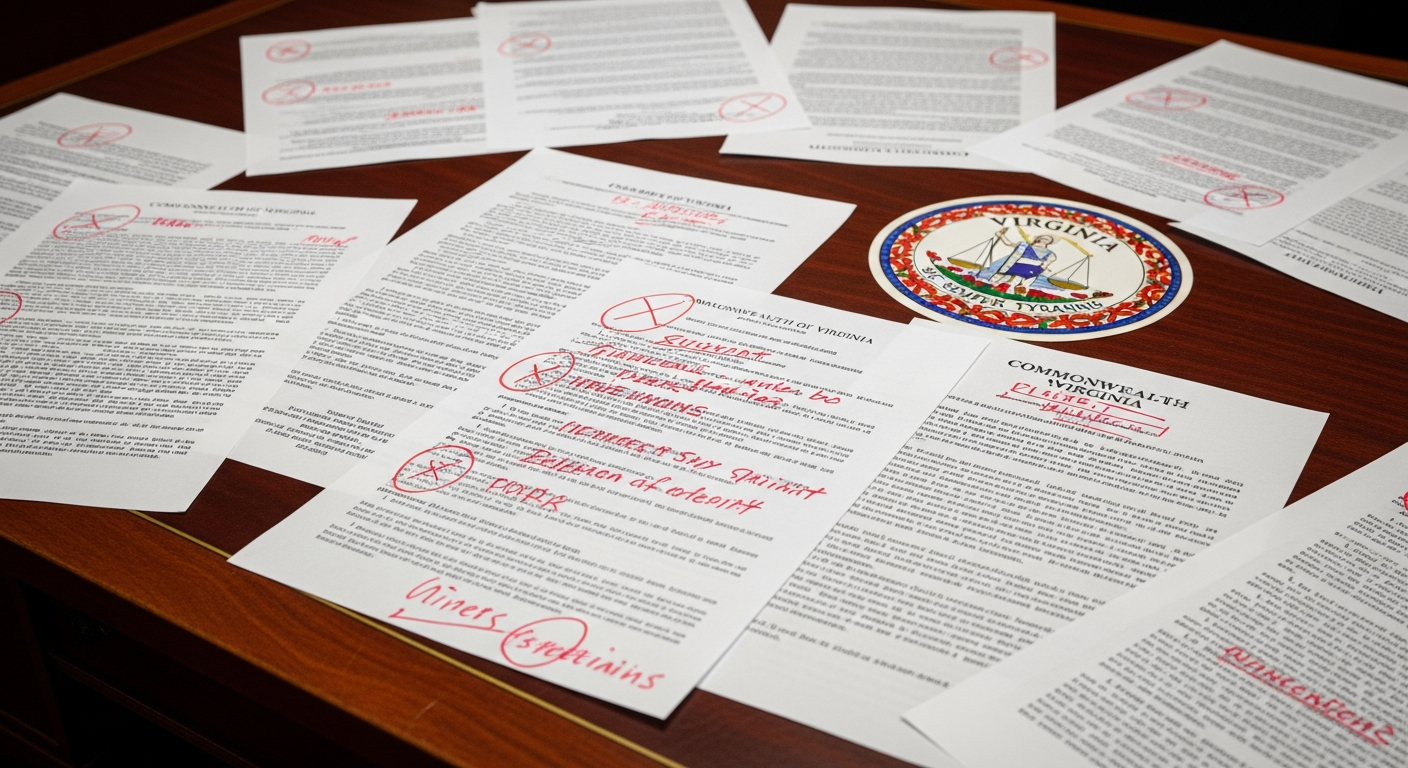
Virginia Attorney General Jay Jones has escalated a contentious legal battle over the state's congressional map to the U.S. Supreme Court, filing an emergency request for a stay after the Virginia Supreme Court blocked a proposed redistricting referendum. The legal maneuver, intended to reshape Virginia's electoral districts ahead of the 2026 election cycle, quickly became a focal point of widespread commentary on the social media platform X, where users highlighted what they described as significant drafting and spelling errors in the official submission.
"WHEN THE TOP LAWYER FOR THE COMMONWEALTH CANNOT SPELL THE COMMONWEALTH’S NAME AND CANNOT FIND THE COMMONWEALTH’S COURTHOUSE, THE GERRYMANDER IS NOT DEAD ON APPEAL—IT IS DEAD ON ARRIVAL." — M.A. Rothman, Engineer and Author
The underlying dispute centers on a redistricting proposal that critics suggest could produce a heavily skewed congressional map, potentially favoring Democrats. According to reports, one scenario discussed by critics projected a map with a 10-1 Democratic advantage. Attorney General Jones argued in his filing that the Virginia Supreme Court misapplied federal election law and improperly intervened in the legislative authority over redistricting. This emergency request followed an earlier notice of intent to appeal the state court's ruling, signaling an intensified legal push to advance the proposed map amid looming election deadlines.
However, the legal arguments were largely overshadowed by the public's reaction to the filing itself. Screenshots and excerpts circulating on X drew attention to alleged inconsistencies and errors. Users pointed out instances where the emergency request, directed to the U.S. Supreme Court, reportedly referenced the "Supreme Court of Virginia" within its text. This detail fueled a wave of criticism regarding the quality and urgency of the legal submission from the Attorney General's office.
Adding to the scrutiny, an earlier emergency filing from Jones's office was found to contain misspellings such as "Virgnia" instead of Virginia and "Sentator" instead of senator. These errors were confirmed by Resist the Mainstream, a news outlet. The perceived lack of precision prompted sharp reactions from political commentators and public figures. Eric Daugherty of Florida’s Voice posted on X, "LMAO! You can’t make this up," adding, "These people are rushed, panicked, and incompetent!" Conservative commentator Michelle Maxwell echoed this sentiment, writing, "The incompetence is mind blowing."
Former Virginia Attorney General Jason Miyares also weighed in, humorously noting the progression of errors. "Good News: Dems managed to spell Virginia correctly. Bad News: They sent their emergency application to SCOTUS to the wrong court. Baby steps," Miyares wrote, highlighting the alleged misdirection within the document. Engineer and author M.A. Rothman amplified the criticism in a widely shared post, stating, "WHEN THE TOP LAWYER FOR THE COMMONWEALTH CANNOT SPELL THE COMMONWEALTH’S NAME AND CANNOT FIND THE COMMONWEALTH’S COURTHOUSE, THE GERRYMANDER IS NOT DEAD ON APPEAL—IT IS DEAD ON ARRIVAL."
The Virginia Supreme Court's decision to block the referendum process effectively halted the redistricting effort. This ruling has significant implications for the upcoming 2026 election cycle, as election officials have cautioned that time is running short for any map adjustments. Virginia Elections Commissioner Steven Koski reportedly informed the court that a recent Tuesday marked a crucial deadline for changes to congressional maps without disrupting the logistics of primary elections.
Political analysts are closely monitoring the situation. University of Virginia professor Larry Sabato suggested that if the appeal to the U.S. Supreme Court fails, Democrats may be compelled to restart the entire redistricting process in a future election cycle, rather than attempting to salvage the current effort under severely compressed timelines. The Attorney General’s office has not yet issued a public statement directly addressing the viral criticism or the alleged errors highlighted on social media.
What began as a complex constitutional dispute over the authority to draw electoral maps has evolved into a broader political and social media flashpoint. The focus has shifted beyond the legal arguments to the professional conduct and competency demonstrated in the filing itself, making the document a subject of public debate and ridicule. The outcome of the appeal to the U.S. Supreme Court will determine the immediate future of Virginia's congressional redistricting and could set precedents for similar disputes nationwide.

